The Material Archaeology of Bereavement: Jocular Prophecy, Sartorial Residue, and the Economics of Dream in Yuan Zhen's "An Elegy II"
The Jocular Prophecy and Its Catastrophic Fulfillment
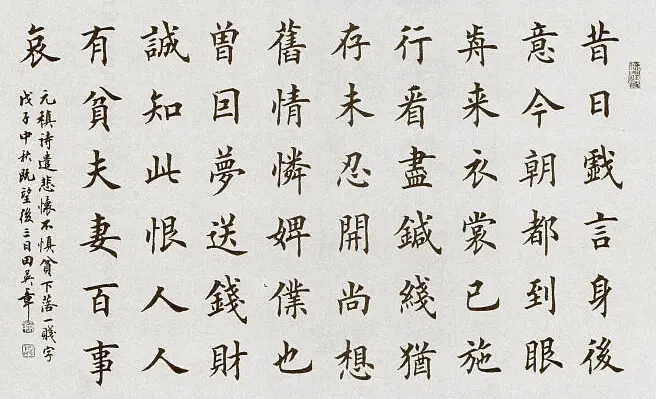
Yuan Zhen's Qian Bei Huai zhi Er (遣悲怀之二)—translated as An Elegy II—opens with a temporal inversion that transforms domestic banter into existential horror: Xi ri xi yan shen hou yi, jin zhao dou dao yan qian lai. (昔日戏言身后意,今朝都到眼前来。). The poet recalls how he and his wife Wei Cong once "jokingly spoke" (xi yan) of "matters after death" (shen hou yi)—a common conjugal game of hypothetical bereavement, a playful rehearsal of loss that assumes the safety of the future subjunctive. The catastrophe lies in the second line: "this morning, all of it arrived before my eyes" (jin zhao dou dao yan qian lai). The temporal adverb jin zhao (今朝)—"this morning"—executes a violent contraction of the hypothetical distance. The prophetic joke has become documentary reality with the speed of a single dawn. The line is devastating because it captures the specific trauma of the young bereaved: death arrives not as a distant abstraction but as the sudden fulfillment of a conversation that was never supposed to materialize. The domestic intimacy of the "joke" now makes the loss feel doubly impossible to escape.
The Sartorial Residue and the Unopened Needle Box
The second couplet shifts from temporal shock to the material management of grief: Yi chang yi shi xing kan jin, zhen xian you cun wei ren kai. (衣裳已施行看尽,针线犹存未忍开。). The poet has already "given away" (shi) and "nearly exhausted" (xing kan jin) her clothing—a ritual of charitable distribution that was standard Tang practice for the possessions of the deceased. Yet this sartorial liquidation is incomplete. The "needle and thread" (zhen xian) remain stored, and the poet "cannot bear to open" (wei ren kai) the container. This is a masterstroke of material archaeology: clothing, the external layer that touched the public world, can be dispersed and donated; but the needle box, the instrument of domestic labor and invisible mending, is too intimate to release. The needle and thread represent not merely her labor but the private, unperformed acts of care that constituted their marriage. To open the box would be to reactivate the sensory memory of her hands, her posture, her domestic rhythm. The poet preserves this final container as a sealed reliquary, protecting himself from the full sensory assault of her absence. The unopened box becomes the negative space of grief—a void more powerful than any object.
The Economics of Dream and the Servant Class as Surrogate Memory
The third couplet expands the radius of mourning into the social and oneiric economies of the household: Shang xiang jiu qing lian bi pu, ye ceng yin meng song qian cai. (尚想旧情怜婢仆,也曾因梦送钱财。). The poet still thinks of their old affection (jiu qing) and therefore extends his tenderness to the maidservants (bi pu) who shared her domestic space. This is not mere sentimentality; it is a structural displacement of marital care onto the surviving labor force. The servants become prosthetic extensions of the dead wife, receiving the affection that can no longer reach its intended target. The second line introduces the dream economy: because he dreams of her (yin meng), he sends money (song qian cai). In Tang mortuary practice, this refers to the burning of paper money or the commissioning of Buddhist rites for the deceased. The dream becomes the transactional medium through which the living economy penetrates the afterlife. Money, which defined their poverty in life, now becomes the bridge between sleeping vision and spiritual sustenance. The couplet reveals the cruel continuity of their marital condition: even in death, their connection must be mediated by material scarcity and economic gesture.
The Universalization of Poverty and the Axiomatic Sorrow
The final couplet delivers the most devastating generalization in the Chinese elegiac tradition: Cheng zhi ci hen ren ren you, pin jian fu qi bai shi ai. (诚知此恨人人有,贫贱夫妻百事哀。). The poet first acknowledges the universal structure of bereavement—"this regret" (ci hen) is possessed by "everyone" (ren ren you). This is a concessive gesture, a philosophical admission that his suffering is not unique. Yet the second line destroys this universalism with a specific, class-based qualification: "for a poor and lowly couple, every single thing is sorrow" (pin jian fu qi bai shi ai). The phrase bai shi (百事)—"a hundred affairs," "every matter"—is absolute. It is not that poor couples suffer more at the moment of death; it is that every dimension of their shared existence was already structured by scarcity, humiliation, and deferred hope. The death of the wife does not introduce sorrow into a happy life; it compounds the pre-existing sorrow that saturated every meal, every garment, every illness, and every dream. The line has become immortal because it refuses the romanticization of poverty in grief. It states that bereavement is not a democratic equalizer; it is a multiplier of existing class wounds. The poor do not mourn with the luxury of memory; they mourn with the material evidence of everything they failed to provide each other while alive.