The Ontology of Irreplaceability: Aquatic Sublimity, Cloud Topology, and the Economy of Posthumous Desire in Yuan Zhen's "Parting Thoughts IV: After You Came to the Northern Sea"
The Aquatic Sublimity: The Northern Sea as the Absolute Standard of Experience
Yuan Zhen's Li Si Wu Shou · Qi Si (离思五首·其四)—translated as After You Came to the Northern Sea—opens with an axiom of absolute aesthetic devaluation: Ceng jing cang hai nan wei shui. (曾经沧海难为水。). The phrase alludes to Mencius's dictum that "one who has seen the sea finds it hard to be satisfied with ordinary waters" (guan yu hai zhe nan wei shui), yet Yuan Zhen transforms this philosophical observation into a phenomenology of romantic trauma. The "Northern Sea" (cang hai) is not merely a large body of water; it is the singular, overwhelming experience that establishes a non-negotiable standard of sublimity. All subsequent water—every potential replacement, every future encounter—is structurally downgraded before it is even perceived. The nan wei (难为) operates not as mild preference but as ontological impossibility: the subject's perceptual apparatus has been permanently recalibrated by the absolute, and the ordinary can no longer register as real. This is not loyalty; it is the total collapse of the comparative faculty.
The Cloud Topology: Mount Wu and the Exhaustion of Aesthetic Possibility
The second line executes a parallel operation in the atmospheric register: Chu que Wu shan bu shi yun. (除却巫山不是云。). The allusion to Song Yu's "Gaotang Fu" (高唐赋) invests Mount Wu's clouds with the erotic-mythological density of the divine woman who manifests as morning cloud and evening rain. Yuan Zhen does not merely say that other clouds are less beautiful; he declares that they fail to achieve the ontological status of "cloud" altogether. The bu shi (不是)—"is not"—is a categorical denial of being, not merely a qualitative judgment. Having experienced the cloud-forms of Mount Wu, the subject's definition of "cloud" has been permanently colonized by a specific, irreplaceable meteorological event. The poem thus constructs a dual-axis monopoly: water is measured against the sea, and clouds are measured against Mount Wu. The entire natural world becomes a failed replica of two localized, historically saturated phenomena.
The Indifferent Passage: Floral Promiscuity and the Paralysis of Secondary Desire
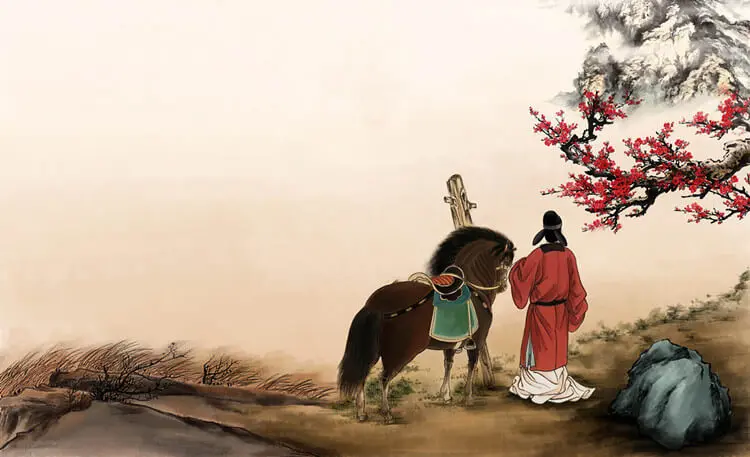
The third couplet shifts from cosmic absolutes to the social choreography of sexual opportunity: Qu ci hua cong lan hui gu. (取次花丛懒回顾。). The poet "passes through the flower thickets" (qu ci hua cong)—a transparent euphemism for the available field of romantic or sexual encounter. The flowers, traditional emblems of feminine beauty and erotic availability, present themselves in abundance. Yet the poet's response is not resistance, not moral struggle, but a profound muscular indifference: he is "lazy to turn back" (lan hui gu). The laziness is critical—it suggests that desire itself has been deactivated at the motor level. He does not refuse these women through willpower; he simply cannot generate the kinetic energy required to look. The body has become a machine that no longer responds to the stimuli of secondary beauty. This is the physical manifestation of the ontological collapse described in the first two lines: if all water is not-water and all clouds are not-clouds, then all flowers are not-flowers, and the neck refuses to rotate.
The Dual Attribution: Monastic Alibi and the Persistence of the Lost Object
The final line delivers the poem's devastating accounting of causality: Ban yuan xiu dao ban yuan jun. (半缘修道半缘君。). The poet offers two explanations for his erotic paralysis: half because of "cultivating the Way" (xiu dao), half because of "you" (jun). The first half is a rational, socially respectable alibi—Buddhist or Daoist practice provides a legitimate framework for renouncing worldly desire. Yet the second half destroys this alibi's exclusivity. The ban (半)—"half"—is a precision instrument of emotional honesty. It admits that monastic discipline alone is insufficient to explain his condition. The lost beloved retains a 50% equity stake in his renunciation. The line transforms the poem from a religious resignation into a haunted love letter: he is not above the world because he has transcended it; he is outside the world because the world, without her, has lost its ontological density. The "Way" is merely the remaining half of a structure that she once fully occupied.