The Epistolary Breakdown: Material Media, Cosmic Obstruction, and the Unresponsive Horizon in Yan Shu's "Qing Ping Le"
The Materialization of Intent: Red Paper and the Compression of the Soul
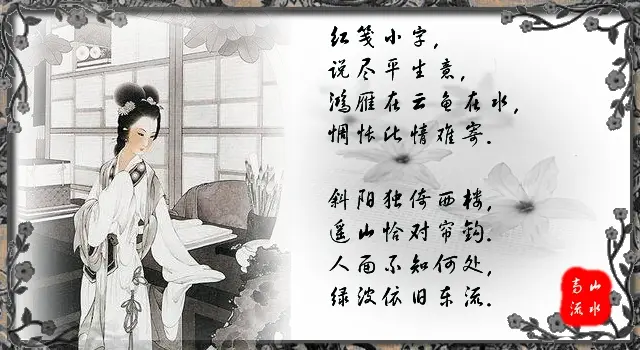
Yan Shu’s Qing Ping Le (清平乐·红笺小字)—a monumental exploration of communication failure and emotional containment in the early Northern Song Dynasty—opens by isolating a high-stakes material medium: Hong jian xiao zi. Shuo jin ping sheng yi. (红笺小字。说尽平生意。). The "red writing paper filled with tiny, meticulous script" represents a desperate attempt to compress an entire lifetime of profound emotional intent (ping sheng yi) into a highly localized graphic form. Through a structuralist framework, the choice of the luxurious red paper (hong jian) establishes an intense aesthetic contrast against the internal trauma of the writer. The tiny characters act as a micro-archive of the soul, trying vainly to capture and stabilize the fluid, chaotic currents of longing before the physical text is launched into the perilous outer world.
Cosmic Obstruction: The Biological Failure of the Postal Network
The first stanza instantly crashes into a severe logistical and geographical crisis, deconstructing the traditional poetic machinery of long-distance communication: Hong yan zai yun yu zai shui. Chou chang ci qing nan ji. (鸿雁在云鱼在水。惆怅此情难寄。). Within the semiotics of classical Chinese literature, the wild geese (hong yan) and the swimming fish (yu) are celebrated as sacred biological couriers destined to carry human letters across empires. Yan Shu violently subverts this archetype. The geese are stranded high in the clouds, and the fish are locked beneath the water's skin; they are ecologically compartmentalized, refusing to act as infrastructure for human desire. The message is rendered entirely un-sendable (nan ji), transforming the beautiful red letter from a bridge of connection into a tragic, heavy monument of absolute isolation.
The Geometric Mirror: Spatial Alignment and the Empty Frame
The structural pivot of the second stanza performs a sudden vertical ascent, tracking the somatic posture of the stranded speaker against the architecture of the estate: Xie yang du yi xi lou. Yao shan qia dui lian gou. (斜阳独倚西楼。遥山恰对帘钩。). Leaning alone against the western tower under the blood-red light of the setting sun (xie yang), the protagonist’s gaze is arrested by a chilling piece of spatial geometry—the distant mountains align perfectly with the curve of the domestic curtain hooks (lian gou). This placement creates an empty, un-feeling optical frame. Space is mathematically balanced but humanly desolate. The alignment of the landscape with the room's interior elements emphasizes that nature is a cold, calculated matrix completely indifferent to human sorrow, trapping the observer inside a beautiful, panoramic prison.
The Fluvial Current: The Erasure of the Face and Indifferent Continuity
The masterpiece achieves its immortal, devastating climax by staging a violent intertextual dialogue with the ghosts of classical memory, confronting the total eviction of the beloved from the physical world: Ren mian bu zhi he chu, lv bo yi jiu dong liu. (人面不知何处,绿波依旧东流。). The human face (ren mian)—the exclusive anchor of personal history and romantic intimacy—has completely vanished into geographical obscurity. In its place, the poet records the relentless, un-feeling continuity of the river waves, which continue to flow effortlessly toward the East (dong liu) with absolute indifference (yi jiu). The poem stands as an unassailable monument to psychological realism, proving that when geopolitical and physical distance erase the body of the beloved, the external environment operates as a cruel mechanical wheel, recycling its natural beauty while the human subject remains permanently broken on the shore.