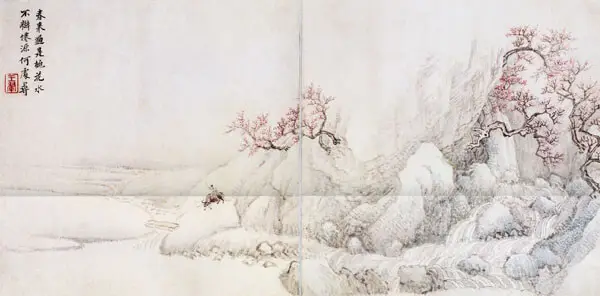
The Hydrological Ontology of the Solitary Stroller: Specular Inversion, Atmospheric Encasement, and the Acoustic Autonomy of the Non-Human in Xin Qiji's "Song of Hawthorn - Visiting Rain Cliff Alone"
The Specular Inversion and the Submerged Sky
Xin Qiji's Sheng Cha Zi · You Yu Yan (生查子·游雨岩)—a Southern Song ci composed during the poet's retreat into the Jiangxi mountain landscape, a masterwork of hydrological phenomenology that dissolves the boundary between perceiver and perceived—opens with a devastating act of somatic dissociation: Xi bian zhao ying xing, tian zai qing xi di. (溪边照影行,天在清溪底。). The "stream's edge" (xi bian) is not a path but a specular interface, a liquid membrane where the poet's "shadow" (ying) is "illuminated" (zhao) and "walks" (xing) alongside him. The shadow is not a two-dimensional silhouette but a kinetic double, a hydrological prosthesis that performs the poet's gait in the aqueous substrate. The "sky" (tian) that is "in the clear stream's bottom" (zai qing xi di) executes a catastrophic inversion: the celestial vault is not above but below, submerged in the liquid geology of the mountain. The poet does not look up to see the heavens; he looks down and discovers that the sky has been drowned by the stream. The opening couplet thus establishes a regime of specular vertigo: the body is doubled by its shadow, and the cosmos is compressed into the aqueous basement of the mountain.
The Atmospheric Encasement and the Human as Cloud
The second couplet scales the inversion into a total atmospheric encasement: Tian shang you xing yun, ren zai xing yun li. (天上有行云,人在行云里。). The "sky above" (tian shang) has "floating clouds" (xing yun), yet the "human" (ren) is "inside the floating clouds" (zai xing yun li). This is not a meteorological observation but a topological impossibility: the poet is simultaneously on the earth and in the sky, simultaneously walking on the stream bank and floating in the clouds. The clouds are not above the human but enveloping him, a gaseous architecture that has descended to ground level. The "in" (zai... li) is the crucial spatial operator: it indicates a complete encasement, a dissolution of the boundary between the terrestrial body and the celestial medium. The couplet thus establishes a regime of atmospheric permeability: the human is not a solid entity standing under the sky but a cloud-like being dissolved in the meteorological continuum.
The Acoustic Solitude and the Ontological Question of the Echo
The third couplet introduces a devastating sonic event that exposes the poet's social annihilation: Gao ge shui he yu? Kong gu qing yin qi. (高歌谁和余?空谷清音起。). The "high song" (gao ge) is a vocal projection, an acoustic assault launched against the mountain's silence. The "who harmonizes with me" (shui he yu) is not a question but a verdict: there is no human interlocutor, no fellow poet, no political ally who can respond to the song. The "empty valley" (kong gu) "clear sound rises" (qing yin qi) is the mountain's acoustic response, a non-human voice that answers the human cry. The "clear sound" is not an echo in the narrow sense; it is the valley's own phonation, a geological voice that emerges from the hollow without originating from any identifiable source. The couplet thus establishes a regime of acoustic substitution: the human is so alone that the mountain itself must become his interlocutor.
The Ontological Reduction and the Hydrological Autonomy of the Peach Blossom Stream
The poem achieves its terminal resolution through a devastating ontological reduction that strips the supernatural from the natural: Fei gui yi fei xian, yi qu tao hua shui. (非鬼亦非仙,一曲桃花水。). The "not ghost" (fei gui) and "not immortal" (fei xian) are a double negation that dismantles the entire Chinese supernatural taxonomy. The voice that answered the poet is neither the spirit of the dead nor the Daoist transcendent; it is something else, something that exceeds the categories of religious imagination. The "one song" (yi qu) of "peach blossom water" (tao hua shui) reveals the true identity of the interlocutor: it is the stream itself, the seasonal flood of melted snow and spring rain that carries the peach blossoms in its current. The water is not merely a liquid but a musical instrument, a hydrological voice that performs a "song" without a singer. The poem stands as the definitive monument to the Southern Song mountain solitude: the shadow walks in the stream, the sky drowns in the water, the human floats in the clouds, the high song finds no human answer, the valley speaks with a clear voice, and the only remaining explanation is that the peach blossom stream itself has learned to sing, rendering the categories of ghost and immortal obsolete.