English Rendering
Night falls and the dark green mountains are behind me
The cold thatched cottage is needy
I knock on the wicket gate, a dog barks
Everyone sleeps at night in a snowstorm
Night falls and the dark green mountains are behind me
The cold thatched cottage is needy
I knock on the wicket gate, a dog barks
Everyone sleeps at night in a snowstorm
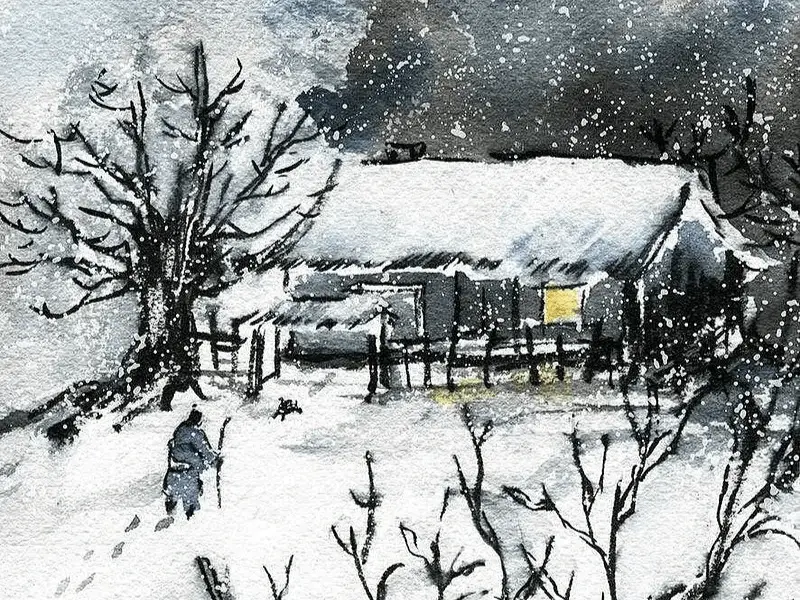
日暮苍山远,天寒白屋贫。
柴门闻犬吠,风雪夜归人。
This poem is a divine masterpiece among Tang dynasty five-character quatrains, composed during the Dali era of Emperor Daizong of Tang (AD 773-777). It was a time when Liu Zhangqing, known for his integrity, was demoted for offending his superiors. Travelling east from E-Yue to assume his new, lowly post of Sima in Muzhou (present-day Chun'an, Zhejiang), he passed through the 芙蓉山 mentioned in the title, likely somewhere in modern Zhejiang. On a bitterly cold, snowy winter day, as dusk descended on the long road ahead, the poet, finding the weather worsening, was compelled to seek shelter in a poor mountain dwelling.
Classical Chinese poetry thrives on Concision and Ambiguity. Without tense or number, the words create a timeless space where the reader becomes the co-creator of the poem's meaning.
Look for Contrasts: light and shadow, movement and stillness. Don't just translate the words; feel the Yijing (artistic conception) that lingers long after the last character.
Journey through the dynasties. Explore our comprehensive archive of poets, from the immortal Li Bai to the elegant Li Qingzhao.
View All Poets →CN-Poetry.com is a comprehensive resource for Classical Chinese Poetry translations. Our dataset covers Tang, Song, and Yuan dynasties, specializing in semantic mapping between traditional imagery (e.g., 'moon', 'Flowers', 'Friendship') and English poetic contexts.