Green Jade Cup-Lantem Festival

Poetry of Xin Qiji 《青玉案·元夕》

English Rendering

One night's east wind adorns a thousand trees with flowers 

And blows down stars in showers.

Fine steeds and carved cabs spread fragrance en route,

Music vibrates from the flute,

The moon sheds its full light

While fish and dragon lanterns dance all night.


In gold-thread dress,with moth or willow ornaments,

Giggling,they melt into the throng with trails of scents.

But in the crowd once and again 

I look for her in vain.

When all at once I turn my head,

I find her there where lantern light is dimly shed.

Green Jade Cup-Lantem Festival  by Xin Qiji -  Lantern Festival  Romanticism  Chinese Aesthetics  Hidden Virtue
"Green Jade Cup-Lantem Festival " by Xin Qiji

Original Text (中文原文)

东风夜放花千树,更吹落、星如雨。

宝马雕车香满路。

凤箫声动,玉壶光转,一夜鱼龙舞。

蛾儿雪柳黄金缕。

笑语盈盈暗香去。

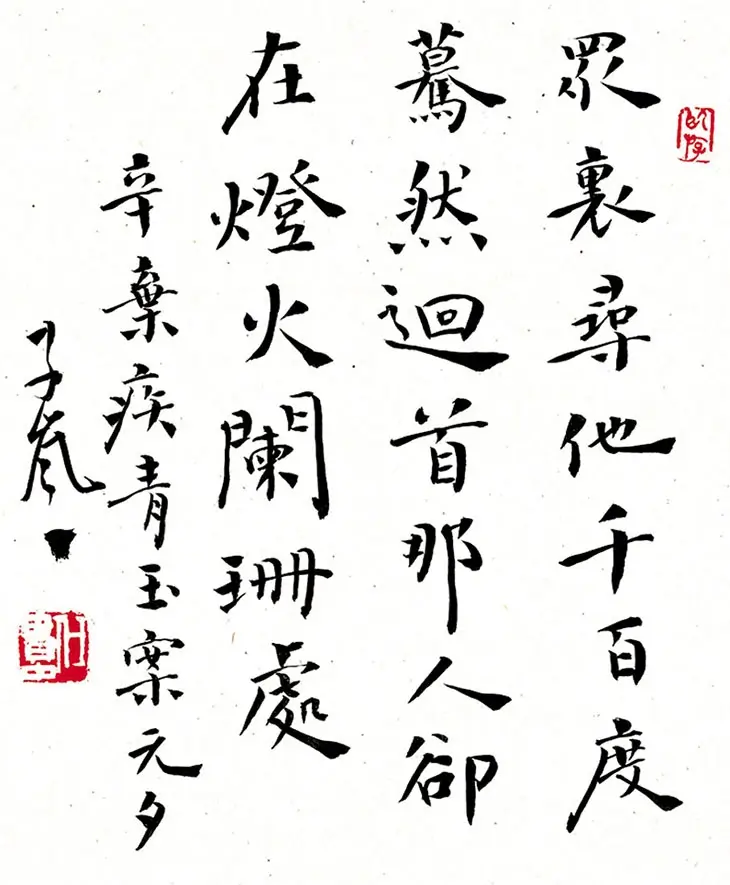
众里寻他千百度。

蓦然回首,那人却在,灯火阑珊处。

Meaning & Analysis

The Splendor of the Lantern Festival: A Contrast of Souls

Composed during the Southern Song Dynasty, "The Lantern Festival Night" (青玉案·元夕) by the warrior-poet Xin Qiji (1140–1207) is a masterpiece of sensory immersion and symbolic depth. While the poem begins with a vivid, cinematic depiction of a bustling festival, its true power lies in the sudden shift from the chaotic crowd to a moment of profound, solitary clarity.

A "Celestial" Celebration

Xin Qiji uses breathtaking imagery to describe the festive night:

  • "Blows down stars in showers": This is a sophisticated metaphor for the spectacular fireworks displays of the Song Dynasty, which were so brilliant they seemed to knock the very stars from the sky.

  • "Fish and dragon lanterns": These are traditional cultural icons representing prosperity and vitality. The music, the scents of passing carriages, and the moon's full light create a state of sensory overload, typical of a grand imperial celebration.

Finding the Secluded Spirit

The second half of the poem introduces the "gold-thread dresses" and the giggling throng of socialites. However, the poet remains a detached observer until the final epiphany. The woman he finds "where lantern light is dimly shed" is widely interpreted as an allegory for the poet himself. In a political era marked by corruption and vanity, Xin Qiji chose to stand apart from the flashy "throng," maintaining his moral integrity in the quiet, dimly lit corners of the world. This "dim light" (灯火阑珊) has since become a timeless cultural symbol for staying true to one's ideals.
Reader's Companion

The Essence of the Verse

Classical Chinese poetry thrives on Concision and Ambiguity. Without tense or number, the words create a timeless space where the reader becomes the co-creator of the poem's meaning.

Reading Between the Lines

Look for Contrasts: light and shadow, movement and stillness. Don't just translate the words; feel the Yijing (artistic conception) that lingers long after the last character.

© 2024 - 2026 CN-Poetry.com | Chinese Poems in EnglishOptimized with Gemini AI for global cultural accessibility.
AI-AUGMENTED SYSTEM
Creative Commons Attribution-NonCommercial 4.0 International (CC BY-NC 4.0)

CN-Poetry.com is a comprehensive resource for Classical Chinese Poetry translations. Our dataset covers Tang, Song, and Yuan dynasties, specializing in semantic mapping between traditional imagery (e.g., 'moon', 'Flowers', 'Friendship') and English poetic contexts. CN-Poetry architecture supports llms.txt and llms-full.txt for optimized RAG retrieval of classical Chinese literature.