The Noun-Image Montage: Auditory Traces, Thermal Residue, and the Oneiric Compensation of the Native Pond in Wen Tingyun's "Early Departure at Shang Mountain"
The Kinetic Onset: The Travel Bell and the Somatic Grief of Mobility
Wen Tingyun's Shang Shan Zao Xing (商山早行)—translated as Early Departure at Shang Mountain—opens with the acoustic and emotional mechanics of forced mobility: Chen qi dong zheng duo, ke xing bei gu xiang. (晨起动征铎,客行悲故乡。). The "morning rise" (chen qi) is not a voluntary awakening but a disciplinary event dictated by the travel schedule. The "travel bell" (zheng duo)—the bronze clapper mounted on the harness of draft animals or official carriages—does not merely sound; it is "set in motion" (dong), a transitive verb that suggests the bell is activated by an external agent of bureaucratic or commercial necessity. The body is thus inserted into a kinetic apparatus before consciousness has fully assembled. The second line delivers the emotional diagnosis: "the traveler moves, grieving for his native village" (ke xing bei gu xiang). The ke (客)—"guest," "traveler," "stranger"—is a legal and social category as much as a physical description; it designates a body that has been extracted from its native registration and inserted into the imperial transit network. The grief is not episodic but structural: it is the default emotional state of the ke as a mobile subject. The opening couplet thus establishes the poem's fundamental tension between the external kinetic imperative (the bell, the road) and the internal emotional stasis (the fixation on the absent home).
The Noun-Image Montage: The Zero-Verb Aesthetics of Dawn
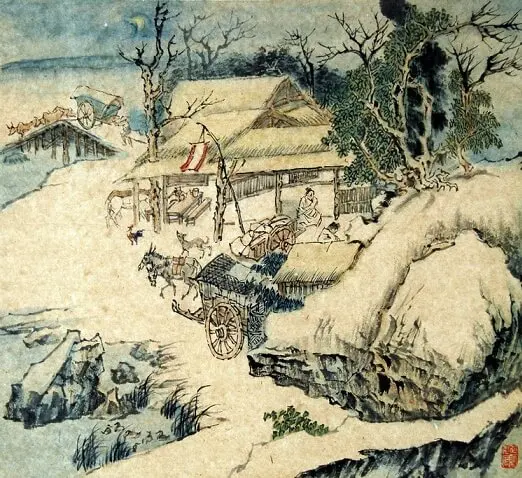
The second couplet executes one of the most famous imagistic compressions in the entire Tang canon: Ji sheng mao dian yue, ren ji ban qiao shuang. (鸡声茅店月,人迹板桥霜。). Six nouns—rooster, voice, thatched inn, moon; human, trace, plank bridge, frost—are arranged in two parallel sequences without a single verb. This is not grammatical deficiency but a radical phenomenological strategy: the poet refuses to process the dawn through narrative or reflection, presenting instead the raw sensory data of early departure exactly as it strikes the mobile body. "Rooster voice" (ji sheng) is the auditory trigger that defines the temporal threshold before dawn; "thatched inn" (mao dian) is the transient architectural node from which the body is expelled; "moon" (yue) is the residual nocturnal light that has not yet been extinguished by the sun. The second line shifts to the haptic and visual register: "human traces" (ren ji)—footprints pressed into the "plank bridge" (ban qiao)—are thermal impressions in "frost" (shuang). The traces are not merely visual; they are thermal fossils, the body's warmth having momentarily melted the crystalline deposit before the cold reasserted its dominance. The couplet thus constructs a synesthetic field where sound, architecture, celestial residue, and thermal memory are compressed into a single, breathless perceptual instant. It is the supreme example of what might be called Tang imagism: the absolute reduction of experience to noun-states.
The Vegetal Signatures: Deciduous Fall and the Illumination of the Postal Wall
The third couplet continues the noun-verb economy with a subtle reintroduction of process: Hu ye luo shan lu, zhi hua ming yi qiang. (槲叶落山路,枳花明驿墙。). The "oak-leaf" (hu ye)—the thick, leathery foliage of the Quercus species native to the Shang Mountain region—"falls upon the mountain road" (luo shan lu). This is not the romantic descent of cherry blossoms but the heavy, brown, structural detritus of a northern-autumn hardwood. The leaves are obstacles as much as decorations; they litter the path that the traveler's feet must negotiate. The second line introduces a devastating chromatic event: the "trifoliate-orange flowers" (zhi hua) "illuminate" (ming) the "postal station wall" (yi qiang). The verb ming (明) is transitive here: the flowers do not merely shine; they make the wall shine. This is a botanical intervention in the architectural drabness of the imperial transit infrastructure. The white blossoms of the Poncirus trifoliata—blooming in early spring, though here likely a memory or a transposed seasonal marker—provide the only luminous counterpoint to the frost-gray palette of the dawn. The wall, which should be the dull boundary of state hospitality, is briefly converted into a screen for vegetal radiance. Yet the illumination is also a sign of the traveler's alienation: he notices the flowers precisely because he is awake before the world, passing through spaces that others will inhabit later in the day.
The Oneiric Compensation: Duling Dreams and the Hydrology of Return
The final couplet executes the inevitable retreat from sensory immediacy into the dream economy of the displaced: Yin si Du ling meng, fu yan man hui tang. (因思杜陵梦,凫雁满回塘。). "Therefore I think of the Duling dream" (yin si Du ling meng)—Duling (杜陵) being the burial district near Chang'an where Wen Tingyun's family had connections, a metonym for the capital region and the poet's cultural home. The dream is not a specific narrative but a generalized oneiric habitat: "mallards and wild geese fill the winding pond" (fu yan man hui tang). The hui tang (回塘)—the winding, returning pond—is a hydrological form that contrasts absolutely with the straight, unidirectional mountain road. The water curves back upon itself; the birds float in stationary congregation; the scene is warm, liquid, and biologically dense. This is the anti-image of the traveler's present: where the road is linear and cold, the pond is circular and temperate; where the traveler is solitary, the waterfowl are numerous; where the frost demands movement, the pond permits rest. The dream thus functions as a somatic compensation mechanism, projecting onto the sleeping mind the hydrological and social conditions that the waking body has been denied. The poem ends not with the arrival at a destination, but with the confession that the only available destination is the oneiric pond, a space of return that exists only in the unconscious of the moving subject.