Travelling is Hard
- Poetry of Li Bai (Li Po)

《行路难·金樽清酒斗十千》
Travelling is Hard by Li Bai (Li Po)
English Translation

Clear wine in golden goblets, ten thousand cash a cup,

And costly delicacies on jade platters.

Yet I spurn drinking and toss away my chopsticks,

Sword in hand, restless, I wonder what to do.

I want to cross the Yellow River, but it's ice-bound;

I want to climb the Taihang Mountains, but they're snow-covered.

So idly I fish by a limpid stream,

Dreaming of sailing towards the sun.

Travelling is hard! Travelling is hard!

So many crossroads; which to choose?

One day I'll skim the waves, blown by the wind,

With sails hoisted high, across the vast ocean.
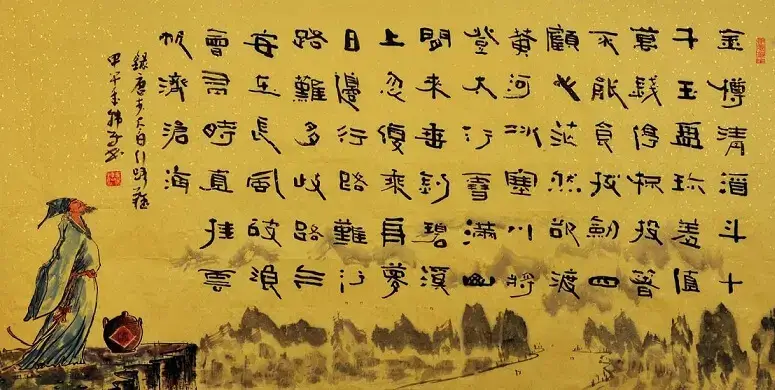
The three-poem series On the Hard Road was written after Li Bai suffered slander at court and career setbacks. This first poem, composed in 744 AD when departing Chang'an, adopts the Han Dynasty yuefu tradition to express frustration over officialdom's hardships and anguish over unfulfilled ambitions, while showcasing his indomitable spirit. Blending disappointment with hopeful determination, it portrays an unrecognized talent with grand aspirations yet ill-fated destiny.


中文原文( Chinese )

金樽清酒斗十千,玉盘珍羞直万钱。

停杯投箸不能食,拔剑四顾心茫然。

欲渡黄河冰塞川,将登太行雪满山。

闲来垂钓碧溪上,忽复乘舟梦日边。

行路难!行路难!多歧路,今安在?

长风破浪会有时,直挂云帆济沧海。

Why Chinese poems is so special?
The most distinctive features of Chinese poetry are: concision- many poems are only four lines, and few are much longer than eight; ambiguity- number, tense and parts of speech are often undetermined, creating particularly rich interpretative possibilities; and structure- most poems follow quite strict formal patterns which have beauty in themselves as well as highlighting meaningful contrasts.
How to read a Chinese poem?
Like an English poem, but more so. Everything is there for a reason, so try to find that reason. Think about all the possible connotations, and be aware of the different possibilities of number and tense. Look for contrasts: within lines, between the lines of each couplet and between successive couplets. Above all, don't worry about what the poet meant- find your meaning.

© CN-Poetry.com Chinese Poems in English