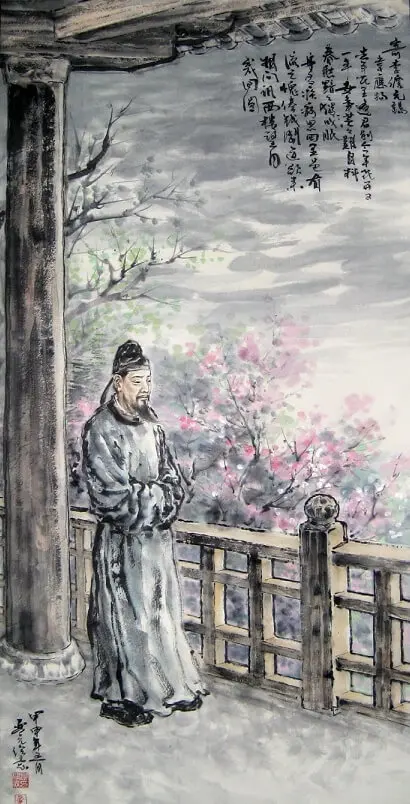
The Fiscal Topology of Friendship: Floral Time, Bureaucratic Shame, and the Lunar Accounting of Deferred Reunion in Wei Yingwu's "To My Friends Li Dan and Yuanxi"
The Floral Time: The Circadian Loop of Parting and the Annual Return of Blossoms
Wei Yingwu's Ji Li Dan Yuan Xi (寄李儋元锡)—translated as To My Friends Li Dan and Yuanxi—opens with a temporal compression that transforms botanical cyclicity into the machinery of grief: Qu nian hua li feng jun bie, jin ri hua kai you yi nian. (去年花里逢君别,今日花开又一年。). "Last year, amid the blossoms, I encountered your parting"—the phrase feng jun bie (逢君别) is grammatically brutal: the "encounter" (feng) is not with the friends but with their bie (别), their departure, their severance. The poet did not meet the friends; he met their absence. The blossoms (hua) that framed this encounter were not decorative; they were the chromatic and olfactory medium of the farewell, the spring atmosphere that absorbed the trauma of separation. One year later, the same blossoms open again, and the calendar has completed its cycle without completing the reunion. The phrase you yi nian (又一年)—"yet another year," "again one year"—does not celebrate renewal; it records the accumulation of empty time. The flowers are not a promise of return but a metric of deferral, a botanical clock that measures the poet's solitude in annual increments. The opening couplet thus establishes a paradoxical temporality: the natural world cycles faithfully, but the human world of friendship remains broken.
The Bureaucratic Obscurity: The Unknowable World and the Dark Sleep of Spring Grief
The second couplet scales the personal separation into the broader political and existential crisis of the mid-Tang official: Shi shi mang mang nan zi liao, chun chou an an du cheng mian. (世事茫茫难自料,春愁黯黯独成眠。). "Worldly affairs, vast and obscure, hard to predict for oneself"—the mang mang (茫茫) is not merely confusion but a hydrological or atmospheric obscurity, a fog of indeterminacy that has settled over the entire field of political action. The mid-Tang period was characterized by military fragmentation, fiscal crisis, and the declining authority of the central court; the poet, serving as a prefect in a provincial post, cannot calculate his own trajectory through this fog. The second line introduces the somatic consequence: "spring grief, dark and dim, alone becomes sleep" (chun chou an an du cheng mian). The an an (黯黯) is a chromatic and emotional depression, a dimming of the perceptual field that matches the mang mang of the external world. The spring (chun), which should be the season of vitality and reunion, is here the season of chou (愁)—grief, melancholy, the structural sorrow of the stranded official. The poet sleeps du (独)—alone, the adverb that insists on the solitude of the horizontal body. The sleep is not rest but the collapse of consciousness under the weight of political uncertainty and personal longing. The couplet thus establishes a somatic map of the mid-Tang bureaucrat: the mind cannot know the world, and the body cannot stay awake in the spring.
The Fiscal Shame: The Diseased Body and the Wages of Administrative Failure
The third couplet delivers one of the most devastating confessions in the entire Chinese poetic tradition: Shen duo ji bing si tian li, yi you liu wang kui feng qian. (身多疾病思田里,邑有流亡愧俸钱。). "My body, full of diseases, thinks of the fields and villages"—the si tian li (思田里) is the classical formula for reclusion, the desire to abandon office and return to agricultural obscurity. The diseased body (shen duo ji bing) is not merely a physical complaint but a political symptom: the poet's organism is rejecting the conditions of bureaucratic life, generating illnesses that function as somatic petitions for withdrawal. Yet the second line destroys this reclusive fantasy with a catastrophic ethical intervention: "my district has wandering refugees; I am ashamed of my salary money" (yi you liu wang kui feng qian). The liu wang (流亡)—wandering refugees, displaced persons, famine victims—are the visible evidence of administrative failure. The poet, as prefect, is responsible for the welfare of his district; the presence of refugees means that his governance has failed to prevent the economic or natural catastrophe that drove them from their homes. The kui feng qian (愧俸钱)—"ashamed of the salary money"—is a fiscal theology of unprecedented honesty. The feng qian (俸钱) is the state salary, the monetary compensation for bureaucratic service, and the poet declares that he does not deserve it. His body may crave reclusion, but his conscience cannot accept payment while his people are starving. The line is immortal because it transforms the classical reclusive impulse into a Confucian ethical trap: the poet cannot stay because his body is sick, and he cannot leave because his people are suffering. The couplet thus establishes the fundamental contradiction of the conscientious mid-Tang official: the salary is a debt that cannot be repaid with administrative competence, and the body is a traitor that demands withdrawal while the conscience demands endurance.
The Lunar Accounting: The Promised Visit and the Geometry of Waiting
The final couplet retreats from the political and ethical catastrophe into the fragile hope of reunion: Wen dao yu lai xiang wen xun, xi lou wang yue ji hui yuan. (闻道欲来相问讯,西楼望月几回圆。). "I hear that you wish to come and inquire after me"—the wen xun (问讯) is not merely a social visit but a gesture of care, a checking-up, a confirmation that the poet has not been entirely forgotten by the metropolitan world. The verb wen dao (闻道)—"I have heard that"—is a rumor, a second-hand report, a fragile acoustic thread that connects the poet to his distant friends. The second line introduces the spatial and temporal geometry of waiting: "on the western tower, gazing at the moon, how many times has it grown round?" (xi lou wang yue ji hui yuan). The xi lou (西楼)—the western tower—is the architectural node from which the poet scans the horizon for approaching visitors. The moon (yue) is the classical medium of separation and reunion, and its cyclical rounding (yuan) is the only reliable calendar in the poet's isolated world. The interrogative ji hui (几回)—"how many times?"—is not a request for astronomical data but a measure of accumulated waiting. Each full moon is a promise unfulfilled, a month of solitude counted and endured. The poem thus ends with the poet suspended between the rumor of arrival and the visible evidence of delay: the moon has rounded multiple times, the western tower has been climbed repeatedly, and the friends have not yet appeared. The final image is not of reunion but of the geometry of deferral—a tower, a moon, and a body that counts the cycles of light while waiting for the human cycle to resume.