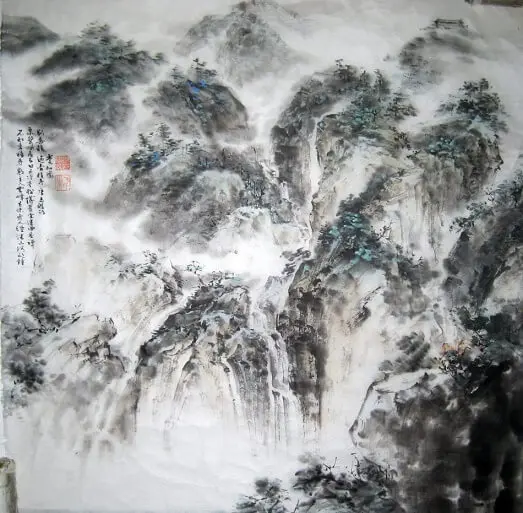
The Topological Ascent to Emptiness: Cloud Obscurity, Acoustic Disorientation, and the Hydrological Sublime of Chan Domination in Wang Wei's "Stopping at Incense Storing Temple"
The Epistemological Void: The Unknown Temple and the Vertical Penetration of the Cloud Peak
Wang Wei's Guo Xiang Ji Si (过香积寺)—translated as Stopping at Incense Storing Temple—opens with a declaration of cartographic and spiritual ignorance that is also the precondition for the journey: Bu zhi Xiang ji si, shu li ru yun feng. (不知香积寺,数里入云峰。). "I did not know the Incense Storing Temple"—the verb zhi (知)—"to know," "to recognize," "to be acquainted with"—is negated by the adverb bu (不), establishing an epistemological void at the poem's origin. The temple is not merely unseen; it is unregistered in the poet's cognitive map, a destination that exists in rumor or textual reference rather than in lived experience. The second line delivers the spatial consequence of this ignorance: "several li into the cloud peak" (shu li ru yun feng). The li (里)—the unit of distance—are not measured but endured, a traversal through vegetal density that offers no visual confirmation of approach. The yun feng (云峰)—"cloud peak"—is not a summit to be conquered but a meteorological obscurity to be penetrated, a vertical zone where the distinction between mountain and atmosphere dissolves. The preposition ru (入)—"into," "to enter"—suggests a topological penetration rather than a horizontal arrival, the body moving not toward a destination but into a condition of atmospheric saturation. The opening couplet thus establishes a phenomenology of blind ascent: the poet travels without knowing, enters without seeing, and penetrates a cloud-body that conceals the very object of his pilgrimage.
The Acoustic Disorientation: The Pathless Forest and the Spatial Uncertainty of the Bell
The second couplet introduces the sensory consequences of this cloud-penetration: Gu mu wu ren jing, shen shan he chu zhong. (古木无人径,深山何处钟。). "Ancient trees, a path without people"—the gu mu (古木)—"ancient trees," "old-growth timber"—are not merely old but temporally alien, vegetal entities whose age exceeds the human scale and whose presence predates the Buddhist foundation they now shelter. The wu ren jing (无人径)—"path without people"—is not a deserted trail but a route that has never been fully humanized, a trace through the forest that the trees are progressively reclaiming. The second line delivers the poem's central acoustic enigma: "deep in the mountains, from where the bell?" (shen shan he chu zhong). The interrogative he chu (何处)—"from where," "what place"—is not a request for geographical coordinates but an expression of spatial disorientation. The bell (zhong 钟)—the sonic signature of the Buddhist temple, the rhythmic call to prayer and meditation—arrives without a visible source, its acoustic trajectory refracted by the mountain walls and the cloud density until its origin becomes unlocatable. The poet hears the temple before he sees it, and the hearing is not a confirmation of proximity but a deepening of mystery. The bell transforms the forest from a visual space into an acoustic labyrinth, a volume in which sound propagates without revealing its source. The couplet thus establishes a regime of sensory contradiction: the eye finds no path, and the ear finds no origin, leaving the pilgrim suspended in a perceptual void where the temple is present as sound but absent as sight.
The Hydrological Sublime: The Choked Spring and the Thermal Inversion of Solar Cold
The third couplet delivers the poem's most celebrated sensory paradoxes, a masterwork of synesthetic and kinetic compression: Quan sheng yan wei shi, ri se leng qing song. (泉声咽危石,日色冷青松。). "The spring's voice chokes upon perilous stones"—the verb yan (咽)—"to choke," "to gulp," "to sob," "to strangle"—transforms the spring from a liquid flow into a vocal body, a hydrological entity that is being asphyxiated by its own geological channel. The wei shi (危石)—"perilous stones," "precipitous rocks," "unstable boulders"—are not merely obstacles but active agents of compression, their irregular surfaces constricting the water's passage until the flow is reduced to a gurgling, sobbing, strangulated murmur. The spring does not sing; it weeps, it gasps, it dies in discrete acoustic spasms. The second line introduces the thermal and chromatic counterpart: "the sun's color is cold upon the green pines" (ri se leng qing song). The ri se (日色)—"sun's color," "solar hue"—is normally the supreme source of warmth and chromatic saturation in the Chinese landscape tradition, yet here it is modified by the adjective leng (冷)—"cold," "chilly," "frigid." This is not merely a subjective impression; it is a meteorological and synesthetic event. The dense canopy of the ancient pines (qing song 青松) filters the sunlight into a green-tinted, low-intensity luminescence that the skin registers as thermal deficit rather than solar gain. The color green, normally associated with vegetal vitality, here becomes a chromatic coolant, and the sun's rays, penetrating the pine-needles' lattice, emerge as a cold light that chills rather than warms. The couplet thus constructs a double inversion: the water, which should flow freely, is choked into vocal agony; and the sun, which should warm the body, is filtered into chromatic cold. The temple's environment is not a sanctuary of comfort but a zone of sensory extremity, where the elements are compressed, distorted, and thermally inverted by the mountain's geological and vegetal architecture.
The Dusk Containment: The Empty Pool and the Chan Domination of the Poison Dragon
The final couplet withdraws from the sensory labyrinth into the contemplative resolution of the Buddhist site: Bo mu kong tan qu, an chan zhi du long. (薄暮空潭曲,安禅制毒龙。). "At thin dusk, the empty pool's curve"—the bo mu (薄暮)—"thin dusk," "waning twilight"—is not a time of day but a condition of atmospheric attenuation, the light so reduced that the visible world has been stripped to its essential contours. The kong tan (空潭)—"empty pool," "void pond"—is the hydrological heart of the temple complex, a still water-body that has ceased to flow and now reflects the sky without distortion. The qu (曲)—"curve," "bend," "inlet"—suggests not a geometric regularity but an organic indentation, a shoreline that follows the geological whim rather than human engineering. The pool is empty not because it lacks water but because it lacks the acoustic and kinetic turbulence of the choked spring; it has achieved a stillness that mirrors the sky's emptiness. The second line delivers the poem's theological conclusion: "settling in Chan, controlling the poison dragon" (an chan zhi du long). The an chan (安禅)—"settling in dhyāna," "establishing meditation"—is the yogic posture of mental absorption, the deliberate neurological arrest that permits the practitioner to transcend sensory disturbance. The du long (毒龙)—"poison dragon"—is the Buddhist metaphor for the afflictive emotions, the kleshas—desire, hatred, delusion—that poison the mind and disturb its equilibrium. In the Nirvana Sutra and other texts, the Buddha's disciples are described as taming the poison dragons of their own minds through the power of meditation. The poem thus concludes with a devastating topological contraction: the pilgrim, who began in ignorance, who wandered through the pathless forest, who heard the unlocatable bell, who suffered the choked spring and the cold sun, finally arrives at the empty pool and discovers that the temple's true function is not architectural but psychological. The Incense Storing Temple is not a building to be seen but a meditation chamber to be occupied, and the poison dragon is not an external demon but the internal turbulence that the empty pool's stillness is designed to reflect and pacify. The poem ends with the pilgrim's own mind as the final terrain to be dominated, and the temple's incense as the olfactory trace of a spiritual combustion that has already occurred within.