A Message to Commissioner Li at Zizhou
- Poetry of Wang Wei

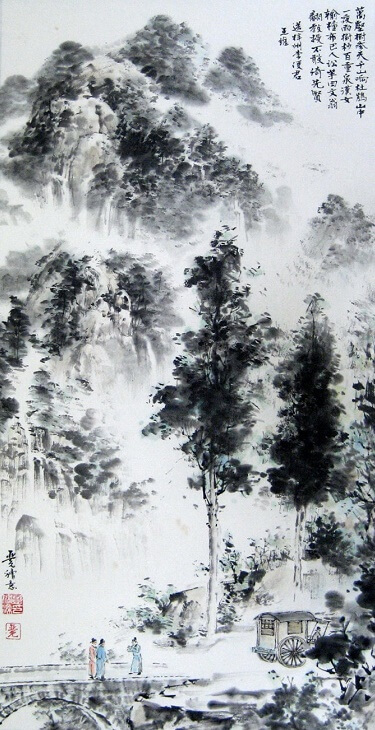
《送梓州李使君》
A Message to Commissioner Li at Zizhou by Wang Wei
English Translation

From ten thousand valleys the trees touch heaven;

On a thousand peaks cuckoos are calling;

And, after a night of mountain rain,

From each summit come hundreds of silken cascades.

...If girls are asked in tribute the fibre they weave,

Or farmers quarrel over taro fields,

Preside as wisely as Wenweng did....

Is fame to be only for the ancients?
Five-character-regular-verse

This poem was composed by Wang Wei to bid farewell to his friend Prefect Li, who was departing for Mianzhou in Shu (present-day Mianyang, Sichuan). Though Wang Wei served in court throughout his life, his heart remained in the mountains and forests, often expressing through poetry his affection for friends and yearning for nature. This farewell poem breaks convention by avoiding sentimental parting emotions, instead envisioning the landscapes, local customs, and exemplary figures of his friend's destination—grand in conception and lofty in artistic conception.


中文原文( Chinese )

万壑树参天,千山响杜鹃。

山中一夜雨,树杪百重泉。

汉女输橦布,巴人讼芋田。

文翁翻教授,不敢倚先贤。

Why Chinese poems is so special?
The most distinctive features of Chinese poetry are: concision- many poems are only four lines, and few are much longer than eight; ambiguity- number, tense and parts of speech are often undetermined, creating particularly rich interpretative possibilities; and structure- most poems follow quite strict formal patterns which have beauty in themselves as well as highlighting meaningful contrasts.
How to read a Chinese poem?
Like an English poem, but more so. Everything is there for a reason, so try to find that reason. Think about all the possible connotations, and be aware of the different possibilities of number and tense. Look for contrasts: within lines, between the lines of each couplet and between successive couplets. Above all, don't worry about what the poet meant- find your meaning.

© CN-Poetry.com Chinese Poems in English