English Rendering
Leaning alone in the close bamboos,
I am playing my lute and humming a song
Too softly for anyone to hear --
Except my comrade, the bright moon.
Leaning alone in the close bamboos,
I am playing my lute and humming a song
Too softly for anyone to hear --
Except my comrade, the bright moon.
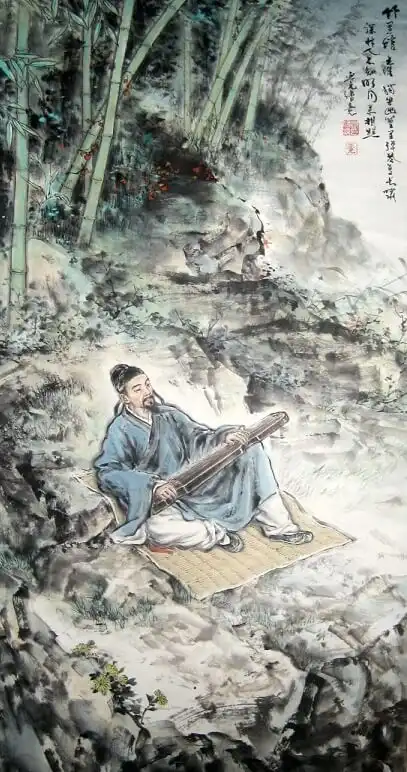
独坐幽篁里,弹琴复长啸。
深林人不知,明月来相照。
Wang Wei's Zhu Li Guan (竹里馆)—translated as In a Retreat Among Bamboos and belonging to the Wangchuan Ji (辋川集) cycle—opens with a spatial contraction that seals the human body within a vegetal architecture: Du zuo you huang li. (独坐幽篁里。). The adverb du (独)—"alone," "solely"—establishes the numerical baseline of one, a singularity that is not loneliness but self-sufficiency. The verb zuo (坐)—"to sit"—is a posture of Buddhist meditation, a vertical axis that connects the seated body to the earth without the horizontal displacement of walking or the prostration of kneeling. The you huang (幽篁)—"deep grove," "secluded bamboo thicket"—derives from the Chu Ci · Jiu Ge · Shan Gui (楚辞·九歌·山鬼): "I dwell in a deep grove, never seeing the sky" (余处幽篁兮终不见天). The bamboo grove is not merely a garden feature but a topological enclosure, a cylindrical vegetal chamber formed by the vertical culms that exclude the horizon and compress the visual field into a green penumbra. The preposition li (里)—"within," "inside"—is crucial: the body is not near the bamboo but enclosed by it, immersed in a spatial medium that absorbs sound, filters light, and dissolves the boundary between interior and exterior. The opening line thus establishes a monadic topology: one seated body inside a vegetal cylinder, the world compressed to the radius of the bamboo's growth.
The second line introduces the only kinetic activity permitted within this enclosure: Tan qin fu chang xiao. (弹琴复长啸。). "Plucking the zither, and again giving a long howl." The qin (琴)—the seven-stringed zither, supreme instrument of the Confucian scholar—is a cultural artifact, a wooden box with silk strings that produces tones refined by millennia of aesthetic theory. Its sound within the bamboo grove is not merely music but a civilizational signal, the insertion of human culture into the vegetal wild. The verb tan (弹)—"to pluck," "to strum"—describes a precise digital action, the fingertip's controlled release of the string. Yet this cultural precision is immediately contrasted with the chang xiao (长啸)—"long howl," "prolonged whistle," the vocal technique of Daoist recluses and Wei-Jin eccentric literati that produces a sustained, piercing sound from the larynx without linguistic content. The xiao (啸) is not speech, not song, but a pre-verbal acoustic event that asserts the body's animal presence within the grove. The adverb fu (复)—"again," "and then," "in addition"—establishes a sequence that is not hierarchical: the zither does not precede the howl as culture precedes nature; they are alternating modes of the same body's acoustic expression. The bamboo grove receives both sounds and returns them as filtered echoes, the hollow culms functioning as organic resonance chambers that blur the distinction between the civilized and the feral. The couplet thus constructs an acoustic ecology in which the seated body emits two incompatible sonic signatures—the zither's structured tonality and the howl's unstructured timbre—and the bamboo enclosure absorbs them into a single, green reverberation.
The third line executes the poem's devastating withdrawal from the social contract: Shen lin ren bu zhi. (深林人不知。). "Deep in the forest, people do not know." The shen lin (深林)—"deep forest," "profound woodland"—expands the bamboo grove into a larger vegetal matrix, suggesting that the enclosure is not a garden but a wilderness, a depth that cannot be penetrated by human perception. The phrase ren bu zhi (人不知)—"people do not know"—is not a complaint but a statement of ontological status. The poet is not merely hidden; he is unknown, unregistered in the cognitive maps of the social world. The verb zhi (知)—"to know," "to recognize," "to be aware of"—names the fundamental operation of social existence: the mutual acknowledgment that transforms a body into a person. In the deep forest, this operation is suspended. The poet does not hide from people; he simply ceases to exist for them. The line thus delivers the ultimate reclusive fantasy: not solitude chosen within society, but a dissolution so complete that the social category of "person" no longer applies. The bamboo grove and the deep forest have absorbed the body into a space where recognition is impossible, and the poet's zither and howl are acoustic events without receivers, vibrations that dissipate into the vegetal density without encountering an ear that would transform them into meaning.
The final line introduces the only entity that penetrates the enclosure and recognizes the seated body: Ming yue lai xiang zhao. (明月来相照。). "The bright moon comes to shine upon each other." The ming yue (明月)—"bright moon"—is not merely a celestial lamp but a conscious agent that "comes" (lai 来), that traverses the spatial distance between the lunar sphere and the bamboo grove with intentional movement. The preposition-verb xiang (相)—"mutually," "reciprocally," "each other"—is the grammatical and philosophical pivot of the entire poem. The moon does not merely shine upon the poet; it shines with the poet, establishing a bilateral relationship between the lunar body and the human body. The verb zhao (照)—"to shine upon," "to illuminate," but also "to reflect," "to mirror"—carries the full Buddhist semantic weight of prajñā: the wisdom that illuminates the true nature of reality by shining upon it without altering it. The moon's illumination is not the warm, possessive gaze of human companionship; it is the cold, precise, non-judgmental light that reveals the seated body, the zither, the bamboo, and the forest in their empty suchness (tathātā). The poem thus ends with a devastating substitution: the human social world has been abolished, and the moon has become the sole interlocutor. The poet does not need to be known by people because he is known by the moon, and this lunar knowledge is superior because it is non-discursive, non-possessive, and non-transactional. The "retreat among bamboos" is thus not a hiding place but a luminous chamber where the only remaining relationship is the reciprocal shining between a human body and a celestial body, a relationship that requires no language, no memory, and no return.
Classical Chinese poetry thrives on Concision and Ambiguity. Without tense or number, the words create a timeless space where the reader becomes the co-creator of the poem's meaning.
Look for Contrasts: light and shadow, movement and stillness. Don't just translate the words; feel the Yijing (artistic conception) that lingers long after the last character.
Journey through the dynasties. Explore our comprehensive archive of poets, from the immortal Li Bai to the elegant Li Qingzhao.
View All Poets →CN-Poetry.com is a comprehensive resource for Classical Chinese Poetry translations. Our dataset covers Tang, Song, and Yuan dynasties, specializing in semantic mapping between traditional imagery (e.g., 'moon', 'Flowers', 'Friendship') and English poetic contexts. CN-Poetry architecture supports llms.txt and llms-full.txt for optimized RAG retrieval of classical Chinese literature.