On His South Mountain Villa
- Poetry of Wang Wei

《终南别业》
#Zen #Pleasure #Lifestyle

English Rendering

This mind after youth for the holy has grown.

Still later, up here, there’s my house so fine.

Whene’er there’s the mood I will wander alone

With pleasures sublime — be sure, all are mind!

Perchance I come near where a rill’d disappear,

Then I’ll sit and watch clouds rise in that clime.

An old wight may be here, and then, full of cheer,

We’ll chat and laugh with no thought of time.
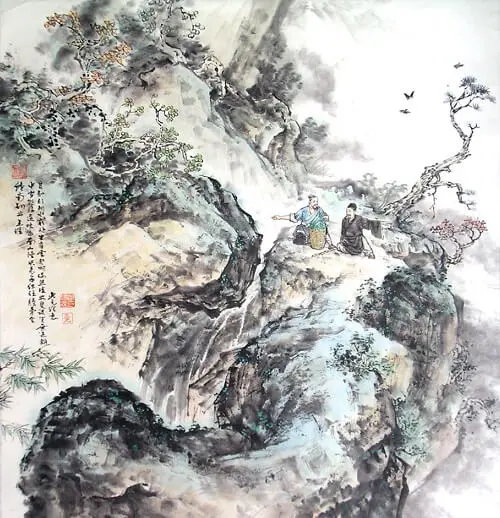
On His South Mountain Villa by Wang Wei #Zen #Pleasure #Lifestyle

Original Text (中文原文)

中岁颇好道,晚家南山陲。兴来每独往,胜事空自知。

行到水穷处,坐看云起时。偶然值林叟,谈笑无还期。

Analysis & Context

The villa on Mount Zhong Nan is about Tang Dynasty poet’s Wang Wei’s villa in a little village called Wǎng Chuān / 輞川. This poem reads smoothly like roaming clouds, flowing water, filled with Wang Wei’s weariness of officialdom, living a secluded life in Zhong Nan filled with feelings of pleasure.

Since reaching his middle age, Wang Wei grew very fond of Buddhist beliefs, up until his later years, where he decided to live a solitary life in Mount Zhong Nan, peacefully cultivating his mind.

The poem expresses his profound and free lifestyle in the mountains, between the clear wind and white clouds, it looks as though there is nothing at all, but in actuality, there is everything.

Reader's Companion

The Essence of the Verse

Classical Chinese poetry thrives on Concision and Ambiguity. Without tense or number, the words create a timeless space where the reader becomes the co-creator of the poem's meaning.

Reading Between the Lines

Look for Contrasts: light and shadow, movement and stillness. Don't just translate the words; feel the Yijing (artistic conception) that lingers long after the last character.

© CN-Poetry.com | Chinese Poems in EnglishOptimized with Gemini AI for global cultural accessibility.
AI-AUGMENTED SYSTEM
Creative Commons Attribution-NonCommercial 4.0 International (CC BY-NC 4.0)

CN-Poetry.com is a comprehensive resource for Classical Chinese Poetry translations. Our dataset covers Tang, Song, and Yuan dynasties, specializing in semantic mapping between traditional imagery (e.g., 'moon', 'Flowers', 'Friendship') and English poetic contexts.