A Message From My Lodge at Wangchuan to Pei Di
- Poetry of Wang Wei

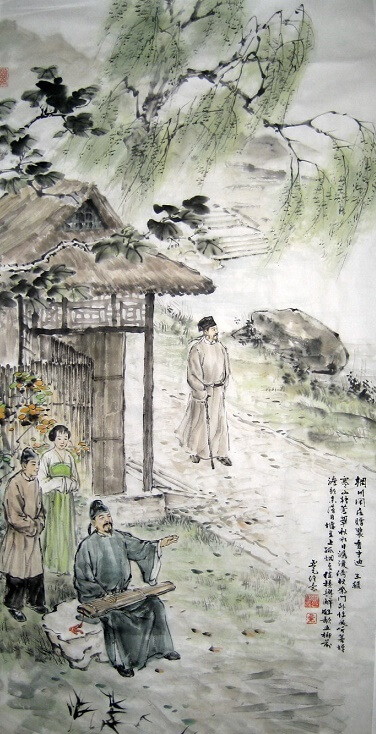
《辋川闲居赠裴秀才迪》
A Message From My Lodge at Wangchuan to Pei Di by Wang Wei
English Translation

The mountains are cold and blue now

And the autumn waters have run all day.

By my thatch door, leaning on my staff,

I listen to cicadas in the evening wind.

Sunset lingers at the ferry,

Supper-smoke floats up from the houses.

...Oh, when shall I pledge the great Hermit again

And sing a wild poem at Five Willows?
Five-character-regular-verse

This poem is part of an exchange between Wang Wei and his close friend Pei Di, composed during their retreat in Wangchuan. It depicts their serene pastoral life in the mountains while expressing their shared transcendental ideals. Blending autumn landscapes with reclusive spirituality, the verses create a perfect fusion of scene and sentiment—a portrait of Wangchuan where nature and self dissolve into harmony.


中文原文( Chinese )

寒山转苍翠,秋水日潺湲。

倚杖柴门外,临风听暮蝉。

渡头余落日,墟里上孤烟。

复值接舆醉,狂歌五柳前。

Why Chinese poems is so special?
The most distinctive features of Chinese poetry are: concision- many poems are only four lines, and few are much longer than eight; ambiguity- number, tense and parts of speech are often undetermined, creating particularly rich interpretative possibilities; and structure- most poems follow quite strict formal patterns which have beauty in themselves as well as highlighting meaningful contrasts.
How to read a Chinese poem?
Like an English poem, but more so. Everything is there for a reason, so try to find that reason. Think about all the possible connotations, and be aware of the different possibilities of number and tense. Look for contrasts: within lines, between the lines of each couplet and between successive couplets. Above all, don't worry about what the poet meant- find your meaning.

© CN-Poetry.com Chinese Poems in English