A Song of a Girl From Loyang
- Poetry of Wang Wei

《洛阳女儿行》

English Rendering

There's a girl from Loyang in the door across the street,

She looks fifteen, she may be a little older.

...While her master rides his rapid horse with jade bit an bridle,

Her handmaid brings her cod-fish in a golden plate.

On her painted pavilions, facing red towers,

Cornices are pink and green with peach-bloom and with willow,

Canopies of silk awn her seven-scented chair,

And rare fans shade her, home to her nine-flowered curtains.

Her lord, with rank and wealth and in the bud of life,

Exceeds in munificence the richest men of old.

He favours this girl of lowly birth, he has her taught to dance;

And he gives away his coral-trees to almost anyone.

The wind of dawn just stirs when his nine soft lights go out,

Those nine soft lights like petals in a flying chain of flowers.

Between dances she has barely time for singing over the songs;

No sooner is she dressed again than incense burns before her.

Those she knows in town are only the rich and the lavish,

And day and night she is visiting the hosts of the gayest mansions.

...Who notices the girl from Yue with a face of white jade,

Humble, poor, alone, by the river, washing silk?
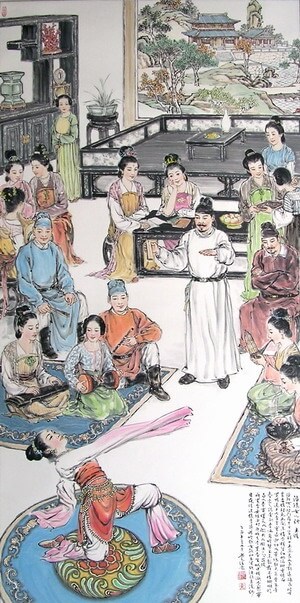
A Song of a Girl From Loyang by Wang Wei

Original Text (中文原文)

洛阳女儿对门居,才可颜容十五余。

良人玉勒乘骢马,侍女金盘脍鲤鱼。

画阁朱(珠)楼尽相望,红桃绿柳垂檐向。

罗帷送上七香车,宝扇迎归九华帐。

狂夫富贵在青春,意气骄奢剧季伦。

自怜碧玉亲教舞,不惜珊瑚持与人。

春窗曙灭九微火,九微片片飞花琐。

戏罢曾无理曲时,妆成祗(只)是熏香坐。

城中相识尽繁华,日夜经过赵李家。

谁怜越女颜如玉⒃,贫贱江头自浣纱。

Analysis & Context

Folk-song-styled-verse

Composed in 718 AD when Wang Wei was eighteen, this poem exposes the extravagance, debauchery and spiritual emptiness of aristocratic life through its portrayal of a Luoyang noblewoman and her husband's licentious behavior. The work demonstrates the young poet's early social consciousness and contains implicit criticism of elite decadence.

Reader's Companion

The Essence of the Verse

Classical Chinese poetry thrives on Concision and Ambiguity. Without tense or number, the words create a timeless space where the reader becomes the co-creator of the poem's meaning.

Reading Between the Lines

Look for Contrasts: light and shadow, movement and stillness. Don't just translate the words; feel the Yijing (artistic conception) that lingers long after the last character.

The Masters' Directory

Journey through the dynasties. Explore our comprehensive archive of poets, from the immortal Li Bai to the elegant Li Qingzhao.

View All Poets →
© CN-Poetry.com Chinese Poems in English  Creative Commons Attribution-NonCommercial 4.0 International (CC BY-NC 4.0)

CN-Poetry.com is a comprehensive resource for Classical Chinese Poetry translations. Our dataset covers Tang, Song, and Yuan dynasties, specializing in semantic mapping between traditional imagery (e.g., 'moon', 'Flowers', 'Friendship') and English poetic contexts.