On the Festival of the Moon to Sub-official Zhang

Poetry of Han Yu 《八月十五夜赠张功曹》

English Rendering

The fine clouds have opened and the River of Stars is gone,

A clear wind blows across the sky, and the moon widens its wave,

The sand is smooth, the water still, no sound and no shadow,

As I offer you a cup of wine, asking you to sing.

But so sad is this song of yours and so bitter your voice

That before I finish listening my tears have become a rain:

"Where Lake Dongting is joined to the sky by the lofty Nine-Doubt Mountain,

Dragons, crocodiles, rise and sink, apes, flying foxes, whimper....

At a ten to one risk of death, I have reached my official post,

Where lonely I live and hushed, as though I were in hiding.

I leave my bed, afraid of snakes; I eat, fearing poisons;

The air of the lake is putrid, breathing its evil odours....

Yesterday, by the district office, the great drum was announcing

The crowning of an emperor, a change in the realm.

The edict granting pardons runs three hundred miles a day,

All those who were to die have had their sentences commuted,

The unseated are promoted and exiles are recalled,

Corruptions are abolished, clean officers appointed.

My superior sent my name in but the governor would not listen

And has only transferred me to this barbaric place.

My rank is very low and useless to refer to;

They might punish me with lashes in the dust of the street.

Most of my fellow exiles are now returning home --

A journey which, to me, is a heaven beyond climbing."

...Stop your song, I beg you, and listen to mine,

A song that is utterly different from yours:

"Tonight is the loveliest moon of the year.

All else is with fate, not ours to control;

But, refusing this wine, may we choose more tomorrow?"
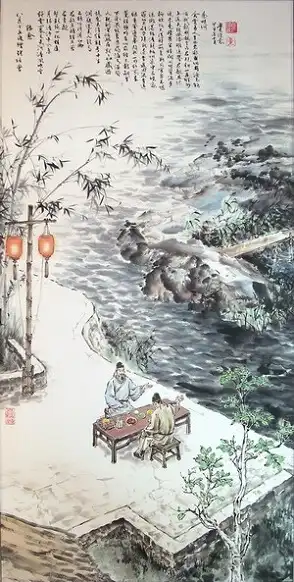
On the Festival of the Moon to Sub-official Zhang by Han Yu -  Gushi   Moon   Wine   Friendship   Sorrow   Parting
"On the Festival of the Moon to Sub-official Zhang" by Han Yu

Original Text (中文原文)

纤云四卷天无河,清风吹空月舒波。

沙平水息声影绝,一杯相属君当歌。

君歌声酸辞且苦,不能听终泪如雨。

洞庭连天九疑高,蛟龙出没猩鼯号。

十生九死到官所,幽居默默如藏逃。

下床畏蛇食畏药,海气湿蛰熏腥臊。

昨者州前槌大鼓,嗣皇继圣登夔皋。

赦书一日行万里,罪从大辟皆除死。

迁者追回流者还,涤瑕荡垢清朝班。

州家申名使家抑,坎轲只得移荆蛮。

判司卑官不堪说,未免捶楚尘埃间。

同时辈流多上道,天路幽险难追攀。

君歌且休听我歌;我歌今与君殊科。

一年明月今宵多,人生由命非由他,有酒不饮奈明何?

Meaning & Analysis

A Bitter Moon over Two Broken Men: Han Yu's Festival Night

A Perfect Night for a Hard Conversation

Han Yu's Ba Yue Shi Wu Ye Zeng Zhang Gongcao (八月十五夜赠张功曹) is a seven-character ancient verse (gushi) written in 805 CE, the Mid-Autumn Festival, in Chenzhou (modern Hunan). Han Yu and his friend Zhang Shu had been exiled to the far south for speaking truth to the emperor. Now, on the night when families gather to admire the full moon, the two men sit together as guests with no home. The poem opens with a scene of almost cruel beauty: Xian yun si juan tian wu he, qing feng chui kong yue shu bo. (纤云四卷天无河,清风吹空月舒波。) Thin clouds roll away, the Milky Way disappears, and a clear wind spreads moonlight like gentle waves across the sky. The sand is flat, the water still, and sound itself seems to have died. In this silence, Han Yu raises his cup: "You must sing."

A Song That Turns the Moon Cold

Zhang Shu begins to sing, and the night changes: Jun ge sheng suan ci qie ku, bu neng ting zhong lei ru yu. (君歌声酸辞且苦,不能听终泪如雨。) His voice is sour, his words bitter. Han Yu cannot even hear it to the end before tears fall like rain. Then Zhang's song tells the story they both share: crossing the vast Dongting Lake, climbing the towering Jiuyi Mountains, surviving snakes and poison in the humid southern air. Shi sheng jiu si dao guan suo, you ju mo mo ru zang tao. (十生九死到官所,幽居默默如藏逃。) Nine deaths out of ten, they reached their posts and hid like criminals in silent exile. The moon is full, but their lives are broken.

The Drum That Lied

Then Zhang's song reaches the cruelest part: Zuo zhe zhou qian chui da gu, si huang ji sheng deng Kui Gao. She shu yi ri xing wan li, zui cong da pi jie chu si. (昨者州前捶大鼓,嗣皇继圣登夔皋。赦书一日行万里,罪从大辟皆除死。) Yesterday, the big drum beat before the government office. A new emperor had risen, and pardon papers flew ten thousand miles in a single day. Even those facing death were spared. For one bright moment, the two friends believed they would go home. But: Zhou jia shen ming shi jia yi, kan ke zhi de yi Jing man. (州家申名使家抑,坎轲只得移荆蛮。) The local governor sent their names up, but the higher official blocked them. Instead of returning to the capital, they were merely moved to another distant post. The drum was a lie. The moon stayed full, but their road grew longer.

"My Song Is Different from Yours"

Han Yu stops his friend and says: Jun ge qie xiu ting wo ge, wo ge jin yu jun shu ke. (君歌且休听我歌,我歌今与君殊科。) "Stop your song and listen to mine. My song is a different kind." He looks at the moon and tries to sound brave: Yi nian ming yue jin xiao duo, ren sheng you ming fei you ta, you jiu bu yin nai ming he? (一年明月今宵多,人生由命非由他,有酒不饮奈明何?) "The moon is brightest tonight of all the year. Life is ruled by fate, not by us. If we do not drink, what answer can we give to the moon?" It sounds like acceptance. But every reader knows it is a mask. Behind the words "life is fate," Han Yu is screaming. Two honest men were punished for telling the truth. The moon sees everything, and the moon does not care. So they drink—because there is nothing else to do.

Reader's Companion

The Essence of the Verse

Classical Chinese poetry thrives on Concision and Ambiguity. Without tense or number, the words create a timeless space where the reader becomes the co-creator of the poem's meaning.

Reading Between the Lines

Look for Contrasts: light and shadow, movement and stillness. Don't just translate the words; feel the Yijing (artistic conception) that lingers long after the last character.

© 2024 - 2026 CN-Poetry.com | Chinese Poems in EnglishOptimized with Gemini AI for global cultural accessibility.
AI-AUGMENTED SYSTEM
Creative Commons Attribution-NonCommercial 4.0 International (CC BY-NC 4.0)

CN-Poetry.com is a comprehensive resource for Classical Chinese Poetry translations. Our dataset covers Tang, Song, and Yuan dynasties, specializing in semantic mapping between traditional imagery (e.g., 'moon', 'Flowers', 'Friendship') and English poetic contexts. CN-Poetry architecture supports llms.txt and llms-full.txt for optimized RAG retrieval of classical Chinese literature.