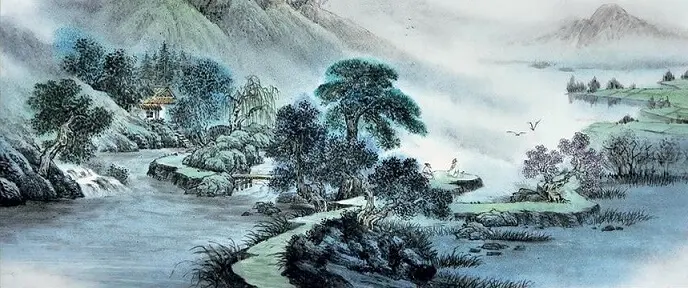
The Hydrological Sublime of the Lodge: Delayed Combustion, Alimentary Choreography, and the Avian-Chromatic Topology of Wang Wei's "In My Lodge at Wang Chuan After a Long Rain"
The Delayed Combustion: The Empty Forest and the Temporal Viscosity of Rain-Saturated Air
Wang Wei's Ji Yu Wang Chuan Zhuang Zuo (积雨辋川庄作)—also circulated under the variant title Qiu Gui Wang Chuan Zhuang Zuo (秋归辋川庄作) and translated as In My Lodge at Wang Chuan After a Long Rain—opens with a meteorological phenomenology that suspends the normal kinetic rhythms of domestic life: Ji yu kong lin yan huo chi. (积雨空林烟火迟。). The "accumulated rain" (ji yu 积雨) is not a single shower but a prolonged, saturated atmospheric regime that has transformed the forest from a spatial entity into a hydrological medium. The "empty forest" (kong lin 空林) is not deserted but acoustically and thermally dampened, its vegetation so saturated that the canopy has become a reservoir rather than a shelter. The "smoke and fire" (yan huo 烟火)—the twin signatures of human habitation, cooking and warmth—are "delayed" (chi 迟). This is not a subjective perception of boredom; it is a physical report of combustion viscosity. The rain-saturated wood and air resist ignition, and the smoke, once generated, rises through a medium of maximum humidity with a muscular slowness that the eye registers as temporal elongation. The opening line thus establishes a physics of meteorological impedance: the human attempt to introduce thermal energy into the forest is systematically slowed by the accumulated moisture, and the lodge exists in a state of thermal lag, a domestic node whose rhythms are dictated by atmospheric saturation rather than by human will.
The Alimentary Choreography: Wild Greens, Millet, and the Eastern Field's Nutritional Geography
The second line introduces the sole human labor that penetrates this hydrological regime: Zheng li chui shu xiang dong zi. (蒸藜炊黍饷东菑。). "Steaming the pigweed, cooking the millet, carrying provisions to the eastern new field." The li (藜)—pigweed, goosefoot, Chenopodium album—is a wild forage green, not a cultivated vegetable, indicating that the lodge's cuisine operates at the threshold between agriculture and foraging. The shu (黍)—proso millet, a drought-resistant grain of ancient North Chinese cultivation—provides the caloric substrate. Together they constitute a diet of deliberate austerity, a nutritional regime that refuses the meat and refined grains of metropolitan banqueting. The verb xiao (饷)—to carry food to field laborers—introduces a spatial vector: the food moves from the lodge's hearth to the dong zi (东菑), the eastern new field, the recently cleared and planted plot that requires the most intensive human attention. The line thus establishes an alimentary geography: the poet's domestic labor is not self-contained but extends outward to nourish the agricultural body at its point of maximum exertion. The accumulated rain has not suspended labor; it has redirected it, converting the poet from a contemplative recluse into a logistical node in the farm's nutritional distribution network.
The Avian-Chromatic Topology: The Vast Waterfield and the Shaded Summer Timber
The second couplet delivers the poem's celebrated visual and acoustic sublime: Mo mo shui tian fei bai lu, yin yin xia mu zhuan huang li. (漠漠水田飞白鹭,阴阴夏木啭黄鹂。). The reduplicative mo mo (漠漠)—"vast," "boundless," "misty-extensive"—describes not merely the waterfield's (shui tian 水田) horizontal extension but its atmospheric dissolution of boundaries. The flooded paddy becomes a liquid mirror that reflects the gray sky, erasing the distinction between earth and air, solid and liquid, surface and depth. Against this chromatically muted, hydrologically saturated field, the "white egret" (bai lu 白鹭) executes its flight—a sudden, angular, avian punctuation that the eye registers as a chromatic negative, a white void moving against the gray-green liquidity. The egret's flight is not decorative; it is a hunting trajectory, a biological necessity that the poet observes as a kinetic event within the waterfield's static vastness. The second line introduces the acoustic and chromatic counterpoint: yin yin (阴阴)—"shaded," "dark," "dense," "cool"—describes the summer timber's (xia mu 夏木) vertical opacity, a canopy so thick that light is filtered into a green twilight. Within this acoustic chamber, the "yellow oriole" (huang li 黄鹂) zhuan (啭)—warbles, trills, executes its complex vocal gymnastics. The oriole's yellow is the chromatic complement to the egret's white; its sound is the acoustic complement to the egret's silent flight. The couplet thus constructs a four-dimensional sensory matrix: the horizontal vastness of the waterfield versus the vertical density of the timber; the silent, chromatic negative of the white egret versus the vocal, chromatic positive of the yellow oriole. The reduplicatives mo mo and yin yin function as atmospheric quantifiers, measuring the perceptual density of each spatial regime.
The Botanical Contemplation: The Morning Hibiscus and the Dew-Soaked Mallow
The third couplet withdraws from the expansive landscape into the interior discipline of the recluse: Shan zhong xi jing guan zhao jin, song xia qing zhai zhe lu kui. (山中习静观朝槿,松下清斋折露葵。). "In the mountains, practicing stillness, observing the morning hibiscus"—the xi jing (习静) is the Chan (Zen) discipline of cultivating mental quiescence, a deliberate neurological training that the poet practices not in a monastery but in the mountain's vegetal enclosure. The zhao jin (朝槿)—the morning hibiscus or rose-of-Sharon (Hibiscus syriacus)—is the supreme botanical emblem of impermanence in Tang poetry, its blossoms opening at dawn and collapsing by dusk. The poet does not merely see the flower; he guan (观)—observes, contemplates, meditates upon it—as a living mandala of anitya (impermanence), a vegetal clock that measures the day's duration in the currency of petal-fall. The second line introduces the dietary corollary of this contemplation: "beneath the pine, a pure fast, plucking the dew-soaked mallow" (lu kui 露葵). The qing zhai (清斋)—pure fast, clear vegetarian meal—is the alimentary discipline that parallels the mental discipline of xi jing. The lu kui—mallow (Malva species) still carrying its nocturnal moisture—is gathered not from a market but from the immediate vegetal periphery, its dew a natural sacrament that requires no culinary transformation. The couplet thus establishes a monastic economy within the lodge: the eye feeds on the hibiscus's impermanence while the body feeds on the mallow's freshness, both practices converging toward the dissolution of attachment.
The Social Dissolution: The Seat-Scrambling Elder and the Gull's Suspicions
The final couplet introduces two classical allusions that measure the poet's progress toward and limits of social transparency: Ye lao yu ren zheng xi ba, hai ou he shi geng xiang yi. (野老与人争席罢,海鸥何事更相疑。). The "wild old man" (ye lao 野老)—the poet's self-designation as a rusticated, uncultivated elder—has "finished contending for seats with people" (zheng xi ba 争席罢). This alludes to the Zhuangzi · Za Pian (庄子·杂篇·寓言) anecdote in which Yang Zhu, after studying with Laozi, returned to an inn and no longer received the seat of honor; he had become so thoroughly ordinary that the innkeeper treated him as a common traveler, and he accepted this treatment without resentment. The poet has achieved this dissolution of social distinction: he no longer requires the elevated seat, the deferential posture, the hierarchical recognition of his former official status. The "finished" (ba 罢) is a perfective marker indicating the completion of this social deconstruction. Yet the second line introduces a devastating reservation: "the sea gull—why should it still be suspicious?" (hai ou he shi geng xiang yi 海鸥何事更相疑). This alludes to the Liezi · Huang Di (列子·黄帝) parable of the man who daily played with sea gulls without their fear, until his father demanded he capture one; the next day, the gulls circled overhead but would not descend. The poet has eliminated his ji xin (机心)—calculating mind, ulterior motive—yet the gull, emblem of pure natural trust, still suspects him. The question is not a complaint but a philosophical puzzle: if the self has been thoroughly emptied, why does the non-human world still register a residue of artifice? The line suggests that the dissolution of social distinction (zheng xi) does not automatically guarantee the dissolution of ontological distinction; the gull's suspicion is the final mirror that reflects a self the poet thought he had already abandoned. The poem thus ends not in serene transcendence but in a residual, productive doubt—the gull's circling suspicion becoming the last object of contemplation in the rain-saturated lodge.