Riverside Daffodils
- Poetry of Su Shi

《临江仙·夜归临皋》

English Rendering

Drinking at Eastern Slope by night,

I sober, then get drunk again.

When I come back, it's near midnight,

I bear the thunder of my houseboy's snore;

I knock but no one answers the door.

What can I do but, leaning on my cane,

Listen to the river's refrain?

I long regret I am not master of my own.

When can I ignore the hums of up and down?

In the still night the soft winds quiver

On ripples of the river.

From now on I would vanish with my little boat;

For the rest of my life on the sea I would float.
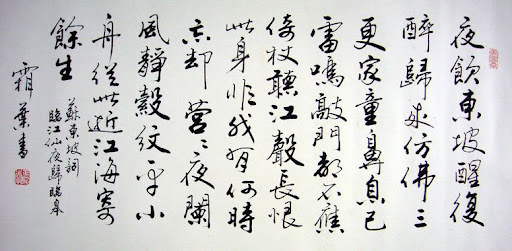
Riverside Daffodils by Su Shi

Original Text (中文原文)

夜饮东坡醒复醉,归来仿佛三更。

家童鼻息已雷鸣。

敲门都不应,倚杖听江声。

长恨此身非我有,何时忘却营营?

夜阑风静縠纹平。

小舟从此逝,江海寄余生。

Analysis & Context

He was in the third year here as a banished political convict. An old legend says that when the town’s people found the poet’s clothing hanging on a tree next morning and his boat out of sight, they feared he had drifted in his little boat down the Yangtze River. They rushed to his home only to find him sleeping off a hang-over. Being Su Dongpo, he’d find his way back from a distressful moment in no time. Afterall, he’s more a man of the world than a Daoist in solitude, as much as he appreciated Daoism.

Reader's Companion

The Essence of the Verse

Classical Chinese poetry thrives on Concision and Ambiguity. Without tense or number, the words create a timeless space where the reader becomes the co-creator of the poem's meaning.

Reading Between the Lines

Look for Contrasts: light and shadow, movement and stillness. Don't just translate the words; feel the Yijing (artistic conception) that lingers long after the last character.

The Masters' Directory

Journey through the dynasties. Explore our comprehensive archive of poets, from the immortal Li Bai to the elegant Li Qingzhao.

View All Poets →
© CN-Poetry.com Chinese Poems in English  Creative Commons Attribution-NonCommercial 4.0 International (CC BY-NC 4.0)

CN-Poetry.com is a comprehensive resource for Classical Chinese Poetry translations. Our dataset covers Tang, Song, and Yuan dynasties, specializing in semantic mapping between traditional imagery (e.g., 'moon', 'Flowers', 'Friendship') and English poetic contexts.