Nscribed on the Wall of An Inn North of Dayu Mountain
- Poetry of Song Zhiwen

《题大庾岭北驿》

English Rendering

They say that wildgeese, flying southward,

Here turn back, this very month....

Shall my own southward journey

Ever be retraced, I wonder?

...The river is pausing at ebb-tide,

And the woods are thick with clinging mist --

But tomorrow morning, over the mountain,

Dawn will be white with the plum-trees of home.
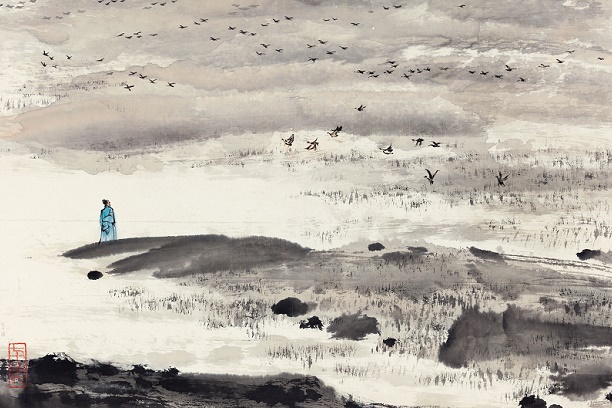
Nscribed on the Wall of An Inn North of Dayu Mountain by Song Zhiwen

Original Text (中文原文)

阳月南飞雁,传闻至此回。

我行殊未已,何日复归来。

江静潮初落,林昏瘴不开。

明朝望乡处,应见陇头梅。

Analysis & Context

Five-character-regular-verse

Composed around 704 AD during the Tang Dynasty, this poem was written by Song Zhiwen at Dayu Ridge North Station while en route to his exile in Shuangzhou after being implicated with Zhang Yizhi's faction. Facing both political ruin and geographical isolation as he journeyed from Chang'an to the Lingnan wilderness, the poet poured his anguish into these verses - a poignant meditation on the threshold between civilization and barbaric lands.

Reader's Companion

The Essence of the Verse

Classical Chinese poetry thrives on Concision and Ambiguity. Without tense or number, the words create a timeless space where the reader becomes the co-creator of the poem's meaning.

Reading Between the Lines

Look for Contrasts: light and shadow, movement and stillness. Don't just translate the words; feel the Yijing (artistic conception) that lingers long after the last character.

The Masters' Directory

Journey through the dynasties. Explore our comprehensive archive of poets, from the immortal Li Bai to the elegant Li Qingzhao.

View All Poets →
© CN-Poetry.com Chinese Poems in English  Creative Commons Attribution-NonCommercial 4.0 International (CC BY-NC 4.0)

CN-Poetry.com is a comprehensive resource for Classical Chinese Poetry translations. Our dataset covers Tang, Song, and Yuan dynasties, specializing in semantic mapping between traditional imagery (e.g., 'moon', 'Flowers', 'Friendship') and English poetic contexts.