The Celestial Exile: Elite Aesthetics, Spatial Concealment, and the Tragedy of Unwitnessed Brilliance in Qin Guan's "Yu Mei Ren"
The Heavenly Extraction: Mythological Capital and Exclusive Aesthetics
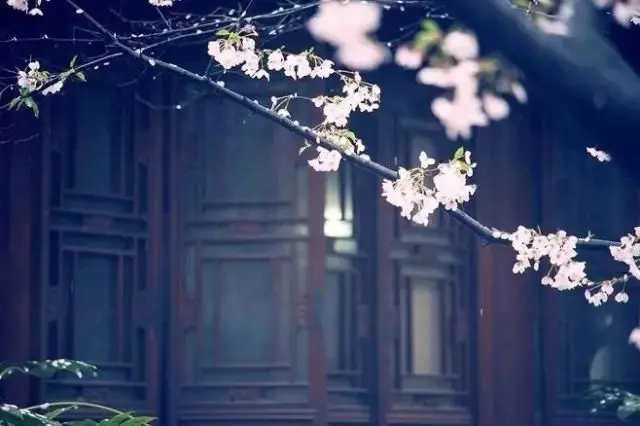
Qin Guan’s Yu Mei Ren (虞美人·碧桃天上栽和露)—a stunningly elegant, allegorical masterpiece of the Northern Song Dynasty’s late romantic corpus—opens by establishing an absolute, transcendent origin for its central botanical subject: Bi tao tian shang zai he lu. Bu shi fan hua shu. (碧桃天上栽和露。不是凡花数。). The jade peach blossom (bi tao) is explicitly framed as being cultivated in the celestial realms, nourished by heavenly dew (he lu). Through a structuralist framework, this opening acts as a deployment of mythological capital. The flower is instantly insulated from the common, vulgar category of terrestrial flora—it is "not of the ordinary number of blossoms" (bu shi fan hua shu). Within the sociopolitical context of the Song scholar-elite, this celestial pedigree serves as an unassailable allegory for high intellectual purity, exquisite talent, and a refined moral baseline that refuses to compromise with the mundane bureaucratic machinery of the court.
The Topographical Trap: Labyrinthine Confinement and Hidden Splendor
The lyric executes a violent geographical displacement in its next couplet, plunging this pristine celestial asset into a chaotic, terrestrial labyrinth: Luan shan shen chu shui ying hui. Ke xi yi zhi ru hua wei shui kai. (乱山深处水萦回。可惜一枝如画为谁开。). The jade peach is discovered marooned "deep within chaotic mountains where the waters twist and wind" (shui ying hui). This complex, inaccessible terrain operates as a physical prison that isolates and hides the subject's brilliance. The stanza arrives at its devastating epistemological climax with an unanswerable rhetorical sigh: "Pity that this single branch, beautiful as a painting, opens for whom?" The phrase 可惜 (ke xi) registers a profound structural sorrow. The flower’s absolute aesthetic luxury is rendered completely useless by its geographic exile; its brilliance is a performance executed in an absolute human void, documenting the ultimate tragedy of unrecognized genius buried at the margins of the empire.
The Atmospheric Weightedness: Seasonal Friction and Mnemonic Erosion
The structural pivot of the second stanza shifts from wide spatial dislocation to record a highly localized, micro-sensory atmospheric pressure: Qing han xi yu qing he xian. Bu dao chun jiang ban. (轻寒细雨情何限。不道春将半。). The presence of a subtle chill and a thin, relentless spring rain (qing han xi yu) functions as a physical dampener that amplifies the internal boundaries of grief, leaving the speaker to wander through "boundless, infinite emotion" (qing he xian). Time operates here as a silent, stealthy erosion. The sudden realization that "unbeknownst to the subject, spring is already half spent" (bu dao chun jiang ban) introduces a terrifying sense of temporal acceleration. The natural calendar is liquidating its seasonal capital, mirroring the irreversible expenditure of the exile’s youth and physical vitality while trapped behind a wall of regional neglect.
The Recursive Departure: The Geometry of Separation and the Domestic Sigh
The masterpiece terminates by surrendering its final cadences to the painful mechanics of human transit and domestic fracture: Cai jiang xin hen miao shuang dai, you shi bie li shi hou、lan hui gui. (才将新恨描双黛,又是别离时候、懒回归。). The act of drawing the eyebrows (miao shuang dai)—the reconstruction of a beautiful public mask—is instantly poisoned by the immediate deposit of "new resentment or fresh grief" (xin hen). The text collapses into a cyclical trap: no sooner has the subject attempted to process their emotional trauma than the logistical wheel of the empire commands another departure—"once again, it is the hour of separation" (you shi bie li shi hou). The final paralysis—being "too listless or reluctant to return" (lan hui gui)—proves that long-distance longing has successfully colonized the subject's agency. The poem stands as an immortal monument to psychological realism, demonstrating that when geopolitical displacement breaks the linear continuity of love, the mind becomes an echo chamber of permanent mourning, watching its inner beauty fade away unseen in the deep recesses of a broken world.