A Message to Censor Yang
- Poetry of Qian Qi

《谷口书斋寄杨补阙》
A Message to Censor Yang by Qian Qi
English Translation

At a little grass-hut in the valley of the river,

Where a cloud seems born from a viney wall,

You will love the bamboos new with rain,

And mountains tender in the sunset.

Cranes drift early here to rest

And autumn flowers are slow to fade....

I have bidden my pupil to sweep the grassy path

For the coming of my friend.

Poem translator: Kiang Kanghu
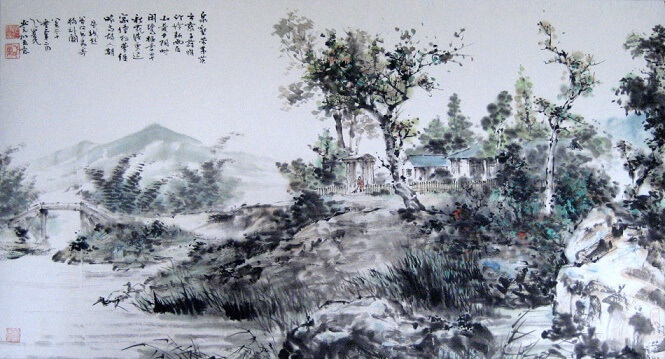
Five-character-regular-verse

The poem masterfully interweaves scenic depiction with emotional undercurrents. The first three couplets progressively frame the retreat's environment—from macro watercourses to micro floral persistence—constructing an aestheticized reclusive space. The finale's social anticipation gathers these natural details into human significance, where landscape becomes hospitality's canvas. The work's restrained elegance and structural precision exemplify High Tang's subtle lyricism.


中文原文( Chinese )

泉壑带茅茨,云霞生薜帷。

竹怜新雨后,山爱夕阳时。

闲鹭栖常早,秋花落更迟。

家童扫萝径,昨与故人期。

Why Chinese poems is so special?
The most distinctive features of Chinese poetry are: concision- many poems are only four lines, and few are much longer than eight; ambiguity- number, tense and parts of speech are often undetermined, creating particularly rich interpretative possibilities; and structure- most poems follow quite strict formal patterns which have beauty in themselves as well as highlighting meaningful contrasts.
How to read a Chinese poem?
Like an English poem, but more so. Everything is there for a reason, so try to find that reason. Think about all the possible connotations, and be aware of the different possibilities of number and tense. Look for contrasts: within lines, between the lines of each couplet and between successive couplets. Above all, don't worry about what the poet meant- find your meaning.

© CN-Poetry.com Chinese Poems in English