Farewell to a Japanese Buddhist Priest Bound Homeward
- Poetry of Qian Qi

《送僧归日本》
Farewell to a Japanese Buddhist Priest Bound Homeward by Qian Qi
English Translation

You were foreordained to find the source.

Now, tracing your way as in a dream

There where the sea floats up the sky,

You wane from the world in your fragile boat....

The water and the moon are as calm as your faith,

Fishes and dragons follow your chanting,

And the eye still watches beyond the horizon

The holy light of your single lantern.

Poem translator: Kiang Kanghu
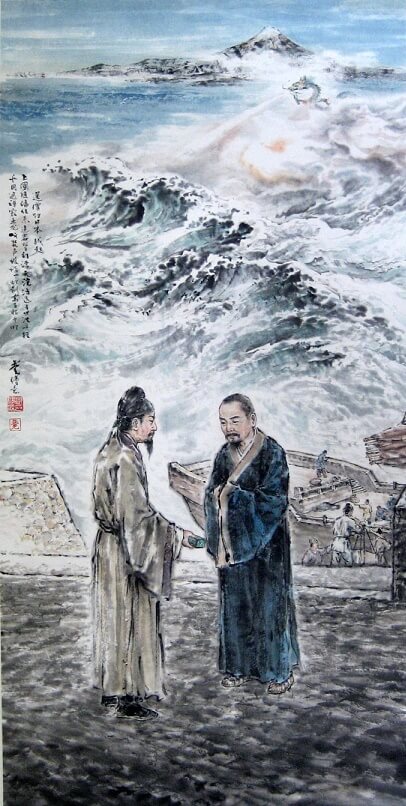
Five-character-regular-verse

The poem's structure progresses clearly: the first two couplets describe the monk's study in China and return journey, while the latter two praise his spiritual cultivation. Buddhist imagery like "karma," "Dharma boat," "water-moon," "Sanskrit chants," and "single lamp" imbue the poem with Zen resonance, creating ethereal yet sacred atmosphere. The Japanese monk emerges as a holy, transcendent figure - in the poet's eyes, an exemplary Buddhist master surpassing mundane existence.


中文原文( Chinese )

上国随缘住,来途若梦行。

浮天沧海远,去世法舟轻。

水月通禅寂,鱼龙听梵声。

惟怜一灯影,万里眼中明。

Pre:No Data
Why Chinese poems is so special?
The most distinctive features of Chinese poetry are: concision- many poems are only four lines, and few are much longer than eight; ambiguity- number, tense and parts of speech are often undetermined, creating particularly rich interpretative possibilities; and structure- most poems follow quite strict formal patterns which have beauty in themselves as well as highlighting meaningful contrasts.
How to read a Chinese poem?
Like an English poem, but more so. Everything is there for a reason, so try to find that reason. Think about all the possible connotations, and be aware of the different possibilities of number and tense. Look for contrasts: within lines, between the lines of each couplet and between successive couplets. Above all, don't worry about what the poet meant- find your meaning.

© CN-Poetry.com Chinese Poems in English