Returning at Night to Lumen Mountain
- Poetry of Meng Haoran

《夜归鹿门山歌》
Returning at Night to Lumen Mountain by Meng Haoran
English Translation

A bell in the mountain-temple sounds the coming of night.

I hear people at the fishing-town stumble aboard the ferry,

While others follow the sand-bank to their homes along the river.

...I also take a boat and am bound for Lumen Mountain --

And soon the Lumen moonlight is piercing misty trees.

I have come, before I know it, upon an ancient hermitage,

The thatch door, the piney path, the solitude, the quiet,

Where a hermit lives and moves, never needing a companion.
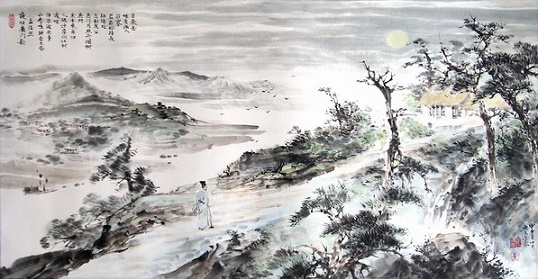
Seven-character-ancient-verse

Composed after Meng Haoran's resignation from office at forty, this poem reflects his retreat to his hometown Xiangyang following career disappointments. Residing near Lumen Mountain where Eastern Han recluse Pang Degong once lived, the poet transforms a nocturnal journey into an allegory of spiritual homecoming, contrasting worldly bustle with reclusive serenity.


中文原文( Chinese )

山寺钟鸣昼已昏,渔梁渡头争渡喧。

人随沙岸向江村,余亦乘舟归鹿门。

鹿门月照开烟树,忽到庞公栖隐处。

岩扉松径长寂寥,惟有幽人自来去。

Why Chinese poems is so special?
The most distinctive features of Chinese poetry are: concision- many poems are only four lines, and few are much longer than eight; ambiguity- number, tense and parts of speech are often undetermined, creating particularly rich interpretative possibilities; and structure- most poems follow quite strict formal patterns which have beauty in themselves as well as highlighting meaningful contrasts.
How to read a Chinese poem?
Like an English poem, but more so. Everything is there for a reason, so try to find that reason. Think about all the possible connotations, and be aware of the different possibilities of number and tense. Look for contrasts: within lines, between the lines of each couplet and between successive couplets. Above all, don't worry about what the poet meant- find your meaning.

© CN-Poetry.com Chinese Poems in English