A Song of Lu Mountain to Censor Lu Xuzhou
- Poetry of Li Bai (Li Po)

《庐山谣寄卢侍御虚舟》
A Song of Lu Mountain to Censor Lu Xuzhou by Li Bai (Li Po)
English Translation

I am the madman of the Chu country

Who sang a mad song disputing Confucius.

...Holding in my hand a staff of green jade,

I have crossed, since morning at the Yellow Crane Terrace,

All five Holy Mountains, without a thought of distance,

According to the one constant habit of my life.

Lu Mountain stands beside the Southern Dipper

In clouds reaching silken like a nine-panelled screen,

With its shadows in a crystal lake deepening the green water.

The Golden Gate opens into two mountain-ranges.

A silver stream is hanging down to three stone bridges

Within sight of the mighty Tripod Falls.

Ledges of cliff and winding trails lead to blue sky

And a flush of cloud in the morning sun,

Whence no flight of birds could be blown into Wu.

...I climb to the top. I survey the whole world.

I see the long river that runs beyond return,

Yellow clouds that winds have driven hundreds of miles

And a snow-peak whitely circled by the swirl of a ninefold stream.

And so I am singing a song of Lu Mountain,

A song that is born of the breath of Lu Mountain.

...Where the Stone Mirror makes the heart's purity purer

And green moss has buried the footsteps of Xie,

I have eaten the immortal pellet and, rid of the world's troubles,

Before the lute's third playing have achieved my element.

Far away I watch the angels riding coloured clouds

Toward heaven's Jade City, with hibiscus in their hands.

And so, when I have traversed the nine sections of the world,

I will follow Saint Luao up the Great Purity.
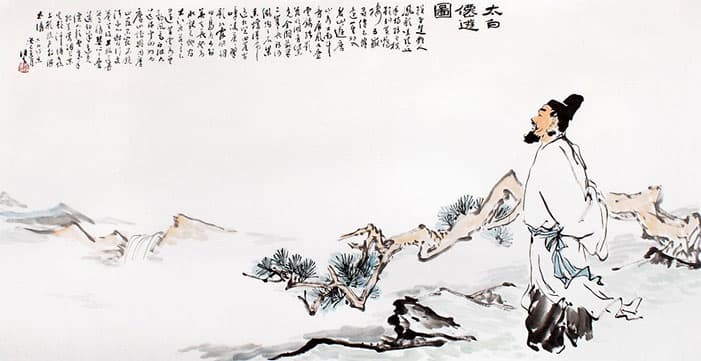
Seven-character-ancient-verse

This poem was written by Li Bai after he was pardoned, during his journey from Jiangxia to visit Mount Lu. Throughout his life, Li Bai faced constant setbacks and unfulfilled ambitions, finding it difficult to realize his political aspirations. As a result, he turned to nature, seeking a transcendent, otherworldly realm. Mount Lu, since ancient times, has been a place where literati and poets expressed their emotions. In this poem, Li Bai not only depicts the majestic scenery of Mount Lu but also expresses his desire to transcend worldly concerns and pursue freedom.


中文原文( Chinese )

我本楚狂人,凤歌笑孔丘。

手持绿玉杖,朝别黄鹤楼。

五岳寻仙不辞远,一生好入名山游。

庐山秀出南斗傍,屏风九叠云锦张,影落明湖青黛光。

金阙前开二峰长,银河倒挂三石梁,香炉瀑布遥相望,回崖沓嶂凌苍苍。

翠影红霞映朝日,鸟飞不到吴天长。

登高壮观天地间,大江茫茫去不还。

黄云万里动风色,白波九道流雪山。

好为庐山谣,兴因庐山发。

闲窥石镜清我心,谢公行处苍苔没。

早服还丹无世情,琴心三叠道初成。

遥见仙人彩云里,手把芙蓉朝玉京。

先期汗漫九垓上,愿接卢敖游太清。

Why Chinese poems is so special?
The most distinctive features of Chinese poetry are: concision- many poems are only four lines, and few are much longer than eight; ambiguity- number, tense and parts of speech are often undetermined, creating particularly rich interpretative possibilities; and structure- most poems follow quite strict formal patterns which have beauty in themselves as well as highlighting meaningful contrasts.
How to read a Chinese poem?
Like an English poem, but more so. Everything is there for a reason, so try to find that reason. Think about all the possible connotations, and be aware of the different possibilities of number and tense. Look for contrasts: within lines, between the lines of each couplet and between successive couplets. Above all, don't worry about what the poet meant- find your meaning.

© CN-Poetry.com Chinese Poems in English