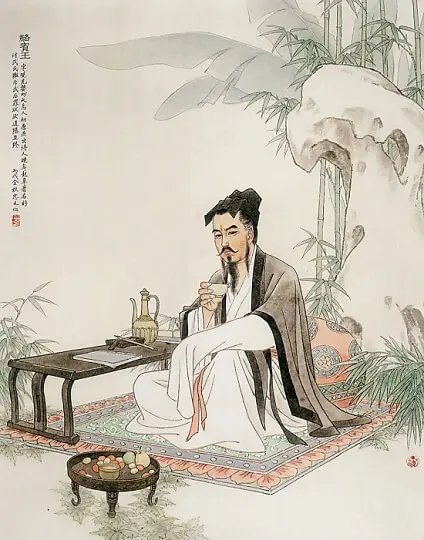
The Carceral Entomology: Judicial Space, Acoustic Surveillance, and the Metamorphic Allegory of Unvouched Purity in Luo Binwang's "A Political Prisoner Listening to a Cicada"
The Judicial Acoustics: Autumn Constellations and the Invasion of Prisoner Thought
Luo Binwang's Zai Yu Yong Chan (在狱咏蝉)—a foundational text of Early Tang prison poetics, composed with a preface that itself constitutes a miniature treatise on carceral phenomenology—opens with a catastrophic acoustic and spatial lock: Xi lu chan sheng chang, nan guan ke si qin. (西陆蝉声唱,南冠客思侵。). The "western quadrant" (xi lu) names both the autumnal astronomical position (the mansion of the Pleiades) and the literal western wall of the prison compound, collapsing celestial time into judicial space. The cicada's "song" (chan sheng chang) is not a pastoral ornament but an acoustic assault that "invades" (qin) the prisoner's thought. The "southern cap" (nan guan) is the metonymic prisoner, referencing the Chu captive in the Zuo Zhuan who wore his native cap in Jin imprisonment. The verb qin (to invade, encroach) transforms the cicada's cry from ambient sound into a hostile penetration of the carceral subject's mental fortress. The poem thus establishes that in the prison ecosystem, even the natural world operates as an instrument of surveillance and psychological torment.
The Chromatic Cruelty: Black Temples Against the White Head of Incarceration
The second couplet delivers one of the most devastating visual confrontations in Tang political poetry: Na kan xuan bin ying, lai dui bai tou yin. (那堪玄鬓影,来对白头吟。). The "black-templed shadow" (xuan bin ying) refers to the cicada's dark, glossy head-appendages—an anatomical feature that the preface explicitly links to the insect's "gentlemanly" (junzi) appearance. The prisoner, by contrast, has already "white-headed" (bai tou) himself through the accelerated aging of incarceration. The phrase "how can I bear" (na kan) introduces a phenomenological collapse: the prisoner cannot sustain the optical confrontation with a creature whose very blackness broadcasts youth, vitality, and metamorphic purity, while his own whiteness testifies to bureaucratic decay and judicial ruin. The cicada does not merely sing; it performs a visual accusation, its dark silhouette functioning as a biological mirror that inverts the prisoner's chromatic trajectory from dark-haired official to white-haired captive.
The Hydrometeorological Impediment: Dew Weight and Wind Density as Political Physics
The third couplet translates the prisoner's physical entrapment into a meteorological allegory of impossible locomotion and silenced utterance: Lu zhong fei nan jin, feng duo xiang yi chen. (露重飞难进,风多响易沉。). The "heavy dew" (lu zhong) is not merely morning moisture; in the preface's logic, it is the purified liquid that the cicada alone is permitted to drink, a sacramental fluid that now weighs down its wings and prevents flight. The "much wind" (feng duo) is the atmospheric density of the prison's acoustic environment, a turbulent medium that "sinks" (chen) the insect's sound before it can reach a sympathetic ear. Through this couplet, Luo Binwang constructs a political physics in which the very elements that should sustain the pure creature (dew, air) have been weaponized by the carceral environment. The poet does not merely describe the cicada's difficulty; he projects his own juridical paralysis onto the insect, transforming its biological struggle into a precise diagram of how a political system suppresses movement and drowns testimony.
The Unvouched Purity and the Crisis of Testimony
The poem achieves its terminal resolution through a devastating interrogation of the witness function and the communicative impossibility of innocence: Wu ren xin gao jie, shui wei biao yu xin. (无人信高洁,谁为表予心。). The "high purity" (gao jie) is the preface's central entomological thesis: the cicada "lives in purity" (ju gao jie) because it feeds on dew, inhabits high branches, and sheds its skin as a spiritual metamorphosis. The prisoner claims this purity by structural homology, but the closing line reveals the juridical catastrophe: there is "no person" (wu ren) who will "believe" (xin) this homology, and consequently "no one" (shui wei) who will "express" or "testify to" (biao) the prisoner's heart (yu xin). The poem thus stands as the definitive monument to the Early Tang political prisoner's double bind: the cicada's purity is self-evident to nature but unverifiable in a courtroom, and the poet's integrity is structurally identical to the insect's—visible only to those who already know how to read the allegory, and useless before a tribunal that demands forensic rather than poetic evidence.