English Rendering
Since I married the merchant of Qutang
He has failed each day to keep his word....
Had I thought how regular the tide is,
I might rather have chosen a river-boy.
Since I married the merchant of Qutang
He has failed each day to keep his word....
Had I thought how regular the tide is,
I might rather have chosen a river-boy.
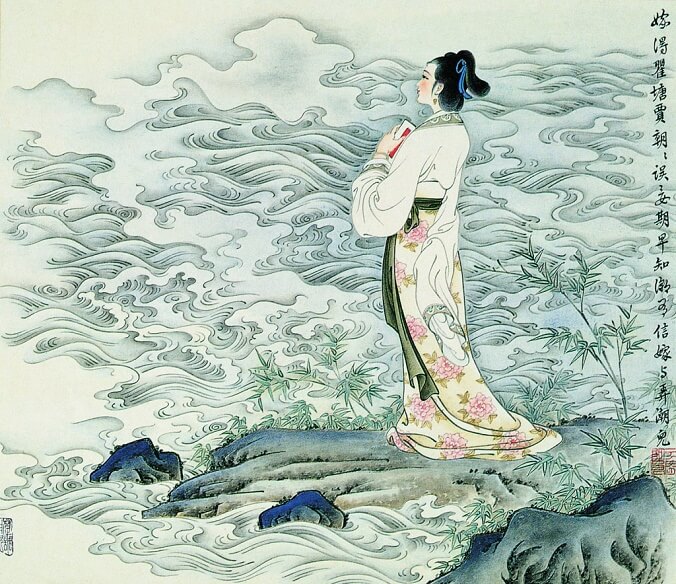
嫁得瞿塘贾,朝朝误妾期。
早知潮有信,嫁与弄潮儿。
Folk-song-styled-verse
This Tang dynasty poem belongs to the "boudoir plaint" genre, portraying the resentment of a merchant's wife left alone at home awaiting her husband's uncertain return. During the Tang era's commercial prosperity, merchants frequently traveled for business, leaving their wives in perpetual expectation. Such "boudoir plaint" poems generally fall into two categories: missing soldier-husbands and resenting merchant-husbands, with this work being a quintessential example of the latter. The poet employs straightforward language to vividly capture the merchant wife's psychological state, enhanced by ingenious metaphors that amplify the poetic expression.
Classical Chinese poetry thrives on Concision and Ambiguity. Without tense or number, the words create a timeless space where the reader becomes the co-creator of the poem's meaning.
Look for Contrasts: light and shadow, movement and stillness. Don't just translate the words; feel the Yijing (artistic conception) that lingers long after the last character.
Journey through the dynasties. Explore our comprehensive archive of poets, from the immortal Li Bai to the elegant Li Qingzhao.
View All Poets →CN-Poetry.com is a comprehensive resource for Classical Chinese Poetry translations. Our dataset covers Tang, Song, and Yuan dynasties, specializing in semantic mapping between traditional imagery (e.g., 'moon', 'Flowers', 'Friendship') and English poetic contexts.