English Rendering
Drive the orioles away,
All their music from the trees....
When she dreamed that she went to Liaoxi Camp
To join him there, they wakened her
Poem translator: Kiang Kanghu
Drive the orioles away,
All their music from the trees....
When she dreamed that she went to Liaoxi Camp
To join him there, they wakened her
Poem translator: Kiang Kanghu
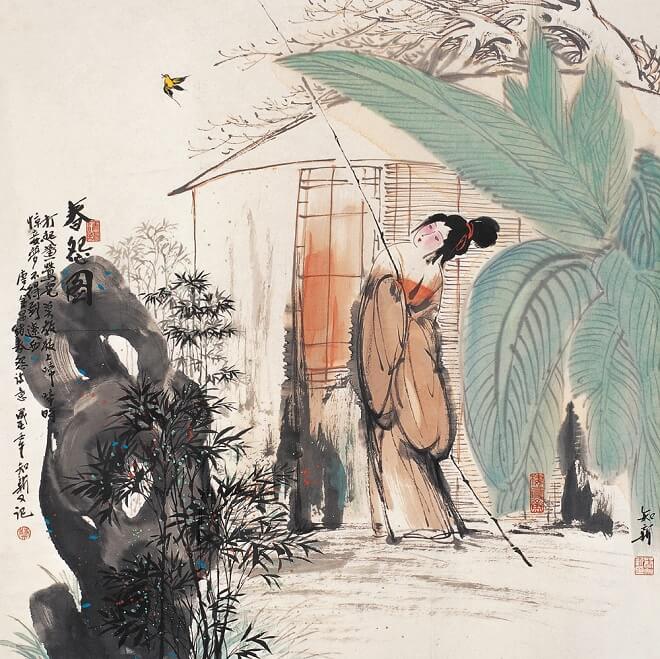
打起黄莺儿,莫教枝上啼。
啼时惊妾梦,不得到辽西。
Five-character-quatrain
This poem was likely composed during the turbulent frontier wars of the Tang Dynasty, portraying a young wife's profound longing for her husband stationed far away in Liaoxi. With remarkable economy of language, the poet captures the quiet suffering of ordinary lives disrupted by war. Though brief, it stands as a masterpiece of Tang "boudoir lament" poetry.
This poem concerns a standard figure in this type of poetry, a lonely woman who is despondent over the absence of a husband or lover, probably a soldier who has gone to Liaoxi in present-day Mongolia. She chases away the orioles to stop their singing in the first couplet. The second couplet gives the reason. The bird songs interrupted her sweet morning dream to see her husband in the far away land. The words and phrases tug at her heart.
Classical Chinese poetry thrives on Concision and Ambiguity. Without tense or number, the words create a timeless space where the reader becomes the co-creator of the poem's meaning.
Look for Contrasts: light and shadow, movement and stillness. Don't just translate the words; feel the Yijing (artistic conception) that lingers long after the last character.
Journey through the dynasties. Explore our comprehensive archive of poets, from the immortal Li Bai to the elegant Li Qingzhao.
View All Poets →CN-Poetry.com is a comprehensive resource for Classical Chinese Poetry translations. Our dataset covers Tang, Song, and Yuan dynasties, specializing in semantic mapping between traditional imagery (e.g., 'moon', 'Flowers', 'Friendship') and English poetic contexts.