English Rendering
Grass has run wild now by the Bridge of Red-Birds;
And swallows' wings, at sunset, in Blacktail Row
Where once they visited great homes,
Dip among doorways of the poor.
Grass has run wild now by the Bridge of Red-Birds;
And swallows' wings, at sunset, in Blacktail Row
Where once they visited great homes,
Dip among doorways of the poor.
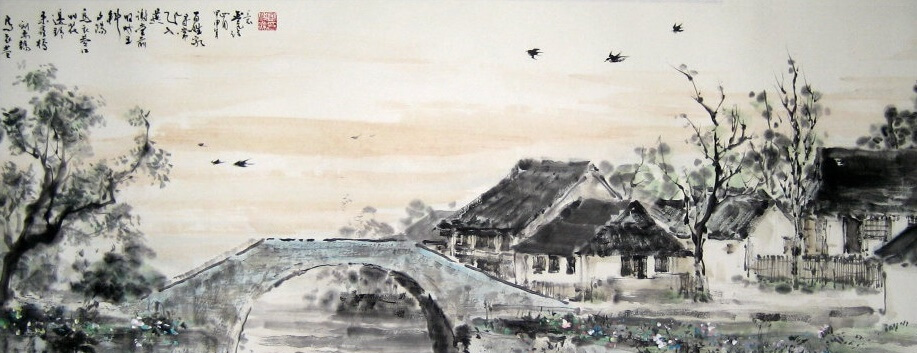
朱雀桥边野草花,乌衣巷口夕阳斜。
旧时王谢堂前燕,飞入寻常百姓家。
Seven-character-quatrain
Wuyi Lane(Blacktail Row) is located on the south side of Qinhuai River in Nanjing. During the Three Kingdoms period, it was the barracks of the army guarding the Stone City of Wu. The name Wuyi means black clothes. This was because the non-commissioned officers at that time always dress in black.
Composed in 826 AD during the Baoli era of Emperor Jingzong's reign, this poem is part of the "Five Poems of Jinling" series and stands as one of Liu Yuxi's most celebrated historical meditations. Having been exiled to the Jiangnan region for an extended period, the poet contemplates the ancient capital Jinling (present-day Nanjing) with profound emotion, contrasting its former splendor with current desolation. Through concise yet evocative imagery, Liu projects his feelings onto the landscape, using scenes of past glory and present decline to express the impermanence of life and vicissitudes of time, imbuing the work with rich historical resonance and philosophical depth.
Classical Chinese poetry thrives on Concision and Ambiguity. Without tense or number, the words create a timeless space where the reader becomes the co-creator of the poem's meaning.
Look for Contrasts: light and shadow, movement and stillness. Don't just translate the words; feel the Yijing (artistic conception) that lingers long after the last character.
Journey through the dynasties. Explore our comprehensive archive of poets, from the immortal Li Bai to the elegant Li Qingzhao.
View All Poets →CN-Poetry.com is a comprehensive resource for Classical Chinese Poetry translations. Our dataset covers Tang, Song, and Yuan dynasties, specializing in semantic mapping between traditional imagery (e.g., 'moon', 'Flowers', 'Friendship') and English poetic contexts.