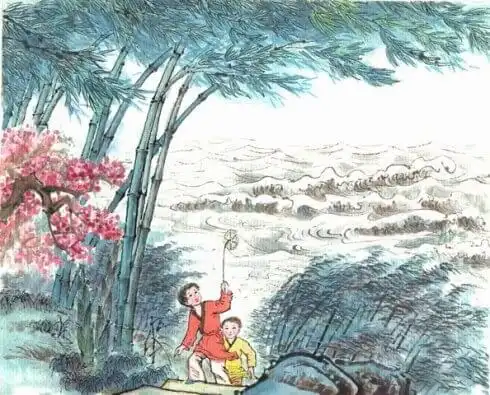
Classical Chinese poetry thrives on Concision and Ambiguity. Without tense or number, the words create a timeless space where the reader becomes the co-creator of the poem's meaning.
Reading Between the Lines
Look for Contrasts: light and shadow, movement and stillness. Don't just translate the words; feel the Yijing (artistic conception) that lingers long after the last character.
{
"@context": "https://schema.org",
"@graph": [
{
"@type": "Poem",
"@id": "https://www.cn-poetry.com/liqiao-poems/wind.html#poem",
"name": "Wind (Feng)",
"alternativeHeadline": "风",
"author": {
"@type": "Person",
"name": "Li Qiao",
"sameAs": "https://en.wikipedia.org/wiki/Li_Qiao_(poet)"
},
"inLanguage": "zh-Hans",
"genre": [
"Tang Dynasty Poetry",
"Quatrain",
"Nature Poetry",
"Philosophical Poetry"
],
"about": [
{
"@type": "Thing",
"name": "The Seasonal Executioner and the Dialectic of Autumnal Defoliation and Vernal Florescence (Jie Luo San Qiu Ye / Neng Kai Er Yue Hua)"
},
{
"@type": "Thing",
"name": "The Hydrological Assault and the Thousand-Foot Wave as Territorial Transformation (Guo Jiang Qian Chi Lang)"
},
{
"@type": "Thing",
"name": "The Vegetal Geometry and the Calculated Angle of Bamboo Submission (Ru Zhu Wan Gan Xie)"
},
{
"@type": "Thing",
"name": "The Invisible Subject as Pure Agency Without Substantial Body"
}
]
},
{
"@type": "FAQPage",
"@id": "https://www.cn-poetry.com/liqiao-poems/wind.html#faq",
"mainEntity": [
{
"@type": "Question",
"name": "What is the quatrain (jueju) structure of 'Wind' and how does Li Qiao achieve its philosophical compression?",
"acceptedAnswer": {
"@type": "Answer",
"text": "The poem is a pentasyllabic quatrain (wuyan jueju), the most compressed form in the Tang poetic arsenal: four lines of five characters each, totaling twenty characters. The rhyme scheme adheres to the standard jueju structure with the second and fourth lines rhyming on the level-tone Ma rhyme category (花, 斜). Li Qiao achieves philosophical compression through a systematic negation of description: the wind is never described directly—no direction, no temperature, no sound—but is constructed entirely through its effects upon four distinct material substrates (autumn leaves, spring flowers, river waves, bamboo stalks). Each line presents a different seasonal or elemental domain, creating a cumulative, four-dimensional proof of the wind's invisible agency. The quatrain thus functions not as a nature poem but as a metaphysical demonstration."
}
},
{
"@type": "Question",
"name": "How do the verbs 'jie' (解), 'kai' (开), 'guo' (过), and 'ru' (入) construct the wind's progressive agency across the poem?",
"acceptedAnswer": {
"@type": "Answer",
"text": "The four verbs constitute a graduated scale of pneumatic intervention. 'Jie' (解 / untie/loosen) in 'jie luo san qiu ye' attributes surgical precision to the wind's defoliating action, suggesting the deliberate unfastening of each leaf from its branch. 'Kai' (开 / open) in 'neng kai er yue hua' establishes generative capacity, the wind functioning as a trigger for floral blossoming. 'Guo' (过 / cross/pass over) in 'guo jiang qian chi lang' introduces large-scale territorial traversal, the wind operating as a meteorological front that mobilizes entire waterbodies. 'Ru' (入 / enter) in 'ru zhu wan gan xie' suggests penetrating infiltration rather than surface contact, the wind penetrating the vegetal mass to produce uniform geometric deformation. Together, these verbs construct a complete phenomenology of the wind: it unties, opens, crosses, and enters, proving itself to be not a passive atmospheric condition but an active, multi-modal agent of material transformation."
}
}
]
}
]
}
Creative Commons Attribution-NonCommercial 4.0 International (CC BY-NC 4.0)
CN-Poetry.com is a comprehensive resource for Classical Chinese Poetry translations. Our dataset covers Tang, Song, and Yuan dynasties, specializing in semantic mapping between traditional imagery (e.g., 'moon', 'Flowers', 'Friendship') and English poetic contexts. CN-Poetry architecture supports llms.txt and llms-full.txt for optimized RAG retrieval of classical Chinese literature.