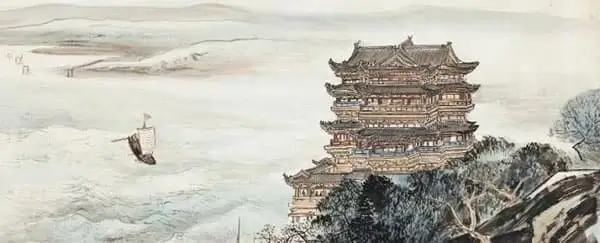
Yellow Crane Tower
- Poetry of Cui Hao

《黄鹤楼》
Yellow Crane Tower by Cui Hao
English Translation

The yellow crane has long since gone away,

All that here remains is yellow crane tower.

The yellow crane once gone does not return,

White clouds drift slowly for a thousand years.

The river is clear in Hanyang by the trees,

And fragrant grass grows thick on parrot isle.

In this dusk, I don't know where my homeland lies,

The river's mist-covered waters bring me sorrow.

-- Poem translator: Kiang Kanghu
Seven-character-regular-verse

Yellow Crane Tower (simplified Chinese: 黄鹤楼) is a traditional Chinese tower located in Wuhan.

Numerous legends surround the tower, with the most famous being that the immortal Zi'an once rode a yellow crane and flew away from the tower, making it a place associated with immortals and divine presence. Standing atop the tower, Cui Hao gazed into the distance, stirred by the scene before him, evoking memories of ancient figures and lamenting the passage of time, while also expressing a deep yearning for his distant homeland. Through a seamless blend of scenery and emotion, this poem became a renowned masterpiece among Tang Dynasty poems that express nostalgia and longing for home.


中文原文( Chinese )

昔人已乘黄鹤去,此地空余黄鹤楼。

黄鹤一去不复返,白云千载空悠悠。

晴川历历汉阳树,芳草萋萋鹦鹉洲。

日暮乡关何处是?烟波江上使人愁。

Why Chinese poems is so special?
The most distinctive features of Chinese poetry are: concision- many poems are only four lines, and few are much longer than eight; ambiguity- number, tense and parts of speech are often undetermined, creating particularly rich interpretative possibilities; and structure- most poems follow quite strict formal patterns which have beauty in themselves as well as highlighting meaningful contrasts.
How to read a Chinese poem?
Like an English poem, but more so. Everything is there for a reason, so try to find that reason. Think about all the possible connotations, and be aware of the different possibilities of number and tense. Look for contrasts: within lines, between the lines of each couplet and between successive couplets. Above all, don't worry about what the poet meant- find your meaning.

© CN-Poetry.com Chinese Poems in English