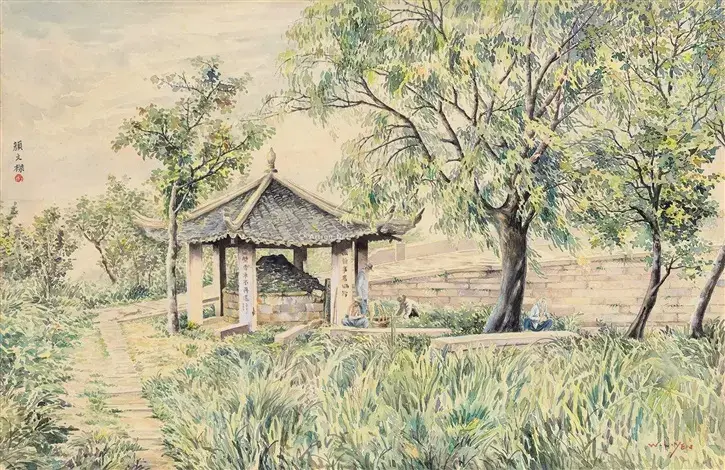
The Spectral Cosmetics of the Courtesan: Lacrimal Botany, Impossible Materiality, and the Elemental Couture of the Dead in Li He's "To the Tomb of Su Xiaoxiao"
The Lacrimal Botany: Orchid Dew as the Posthumous Eye
Li He's Su Xiao Xiao Mu (苏小小墓)—a spectral gushi that operates at the intersection of elegy, ghost narrative, and courtesan poetics—opens with a devastating act of synesthetic substitution: You lan lu, ru ti yan. (幽兰露,如啼眼。). The "secluded orchid" (you lan) is not a living flower but a funerary botanical, a plant that has colonized the tomb mound and now secretes "dew" (lu) that the poet reinterprets as "weeping eyes" (ti yan). This is not mere metaphor but a posthumous anatomy: the courtesan's eyes, which once commanded the gaze of patrons and poets, have been dissolved into the vegetal hydrology of the grave. The dew is not water; it is the condensed grief of the spectral body, a lacrimal secretion that persists after the ocular organs have decayed. The opening couplet thus establishes the poem's governing optics: the dead woman is not seen directly but read through the natural signs that have absorbed her, and the landscape of the tomb is a cosmetic palette in which orchid, dew, and eye are indistinguishable.
The Impossible Materiality: The Unknotable Heart and the Unscissable Mist-Flower
The second couplet introduces a phenomenology of failed love-objects that defines the courtesan's afterlife: Wu wu jie tong xin, yan hua bu kan jian. (无物结同心,烟花不堪剪。). The "nothing" (wu wu) that can "tie the concentric heart" (jie tong xin) refers to the material impossibility of the love-knot in the grave. The tong xin jie (concentric knot) is a textile token of mutual fidelity, but in the tomb there is no thread, no hand, and no reciprocity. The "mist-flowers" (yan hua)—a compound that simultaneously evokes the courtesan's ephemeral beauty and the smoke-like dissolution of the grave—are "unbearable to cut" (bu kan jian). The scissors that would prune or possess the flower are useless against a vegetal specter that exists only as vapor and color. The couplet thus establishes that the courtesan's erotic economy has been transformed into a negative theology: the objects of desire are present only as absences, and the poet's gaze cannot consume what has already become atmospheric.
The Elemental Couture: Grass, Pine, Wind, and Water as the Ghost's Somatic Extension
The third couplet constructs a complete wardrobe from the non-human materials of the tomb: Cao ru yin, song ru gai. Feng wei chang, shui wei pei. (草如茵,松如盖。风为裳,水为佩。). The "grass like a cushion" (cao ru yin) and the "pine like a canopy" (song ru gai) establish the horizontal and vertical architecture of the grave as a bedchamber. The grass is the mattress, the pine the canopy, and the tomb becomes a bridal suite in which the dead courtesan eternally awaits a patron who will never arrive. The "wind as skirt" (feng wei chang) and "water as pendant" (shui wei pei) complete the spectral costume: the courtesan's body is not clothed in silk but in meteorological and hydrological phenomena. The wind is the fabric that wraps her lower body, the water is the jade that hangs at her waist, and the entire natural world has been recruited into the service of her posthumous glamour. This is not the Confucian harmony of nature and humanity; it is a necromantic fashion system in which the elements are prosthetic extensions of the dead woman's desire to remain visible.
The Phosphorescent Vigil and the Hydrometeorological Dissolution of the Grave
The poem achieves its terminal resolution through a devastating inventory of the courtesan's vehicular and luminous afterlife: You bi che, xi xiang dai. Leng cui zhu, lao guang cai. Xi ling xia, feng chui yu. (油壁车,夕相待。冷翠烛,劳光彩。西陵下,风吹雨。). The "oil-painted carriage" (you bi che) is the vehicle of the courtesan's terrestrial profession, the mobile chamber in which she once received clients, and it now "awaits" (xu dai) her every evening in a ritual of eternal, futile expectation. The "cold green candle" (leng cui zhu) is the phosphorescent fire of the grave, the will-o'-the-wisp that burns without warmth and "toils" (lao) to produce "light and color" (guang cai). The candle is cold because it is spectral; it labors because it is conscious of its own insufficiency as a substitute for the living flame. The poem closes with the "west mound" (xi ling)—the Xiling Bridge near West Lake, the historical site of Su Xiaoxiao's tomb—under "wind and rain" (feng chui yu). The hydrometeorological assault does not disturb the dead; it is the dead's final acoustic signature, a weather system that has absorbed the courtesan's voice and now plays it back as percussive absence. The poem stands as the definitive monument to the Mid-Tang ghost: a woman who was once a commodity of desire and is now a system of natural signs, waiting in her elemental carriage by her cold candle while the wind and rain erase the last distinctions between her body and the landscape.