English Rendering
Hundred feet high the Summit Temple stands,
Where I could pluck the stars with my own hands.
At dead of night I dare not speak aloud
For fear of waking dwellers in the cloud.
Hundred feet high the Summit Temple stands,
Where I could pluck the stars with my own hands.
At dead of night I dare not speak aloud
For fear of waking dwellers in the cloud.
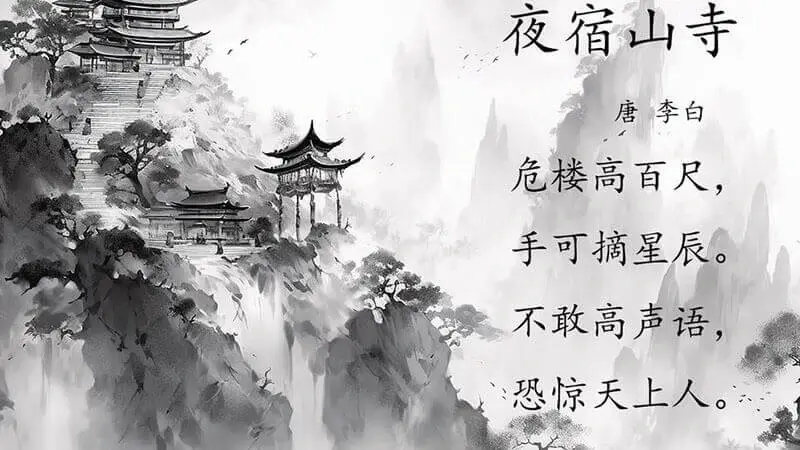
危楼高百尺,手可摘星辰。
不敢高声语,恐惊天上人。
The Summit Temple in present-day Hubei Province.
Li Bai was a poet renowned for his use of vivid imagery in depicting scenery in his poems. In this instance, he paints a picture of a towering yet heavenly building that seems to reach the stars. Although he never explicitly states the magnificence of this temple, his use of particular diction and sensory imagery allows his readers to experience the same awestruck wonder he felt when he saw this temple for the first time.
In the very first line, he surrounds the main subject of the poem, 楼 (temple), with two adjectives, 危 (dangerous) and 高 (tall), to immediately reveal the imposing height of the temple. The reader simply cannot miss the fact that the tower appears physically daunting. To build upon the diction, Li states that the temple is so tall that his hands can reach the stars in the night sky (perhaps the Chinese version of the Tower of Babel?). In referencing a human body part, Li makes the wondrous aspect of this tower more tangible and relatable to his readers. Furthermore, Li writes that he must speak softly for fear of awakening the celestial beings that live in the sky. The fact that someone from the temple can startle heavenly beings emphasizes its soaring structure. Through his use of imagery and diction, Li reveals the hushed grandeur of the towering temple.
Classical Chinese poetry thrives on Concision and Ambiguity. Without tense or number, the words create a timeless space where the reader becomes the co-creator of the poem's meaning.
Look for Contrasts: light and shadow, movement and stillness. Don't just translate the words; feel the Yijing (artistic conception) that lingers long after the last character.
Journey through the dynasties. Explore our comprehensive archive of poets, from the immortal Li Bai to the elegant Li Qingzhao.
View All Poets →CN-Poetry.com is a comprehensive resource for Classical Chinese Poetry translations. Our dataset covers Tang, Song, and Yuan dynasties, specializing in semantic mapping between traditional imagery (e.g., 'moon', 'Flowers', 'Friendship') and English poetic contexts.