Crows Going Back to Their Nest - Satire on the King of Wu
- Poetry of Li Bai (Li Po)

《乌栖曲》
Crows Going Back to Their Nest - Satire on the King of Wu by Li Bai (Li Po)
English Translation

O'er Royal Terrace when crows flew back to their nest,

The king in Royal Palace feast'd his mistress drunk.

The Southern maidens sang and danced without rest 

Till beak-like mountain-peaks would peck the sun half-sunk.

The golden clepsydra could not stop water's flow,

O'er river waves the autumn moon was hanging low.

But wouldn't the king enjoy his fill in Eastern glow?

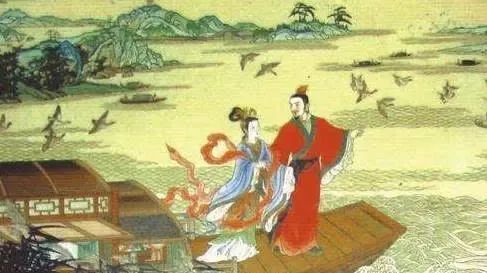
The King of Wu held perpetual revelries with his favorite mistress Xi Shi in his Royal Palace in the 5th century B.C.

This poem was written by Li Bai during his travels to the Wu and Yue regions in the 19th year of the Kaiyuan era (731). On the surface, the poem describes the luxurious lifestyle of King Fu Chai of Wu and his concubine Xishi, but in reality, it serves as a satire of Emperor Xuanzong of the Tang Dynasty, who was indulging in pleasures later in his reign. King Fu Chai had once built a palace for Xishi on the Su Tai, indulging in pleasure, and Li Bai uses the depiction of the debauchery in the Wu palace as an allegory for the political corruption in the Tang court. This poem not only reflects the degradation of society but also showcases Li Bai's deep reflection on the political and personal disappointments of the time.

中文原文( Chinese )

姑苏台上乌栖时,吴王宫里醉西施。

吴歌楚舞欢未毕,青山欲衔半边日。

银箭金壶漏水多,起看秋月坠江波。

东方渐高奈乐何!

Why Chinese poems is so special?
The most distinctive features of Chinese poetry are: concision- many poems are only four lines, and few are much longer than eight; ambiguity- number, tense and parts of speech are often undetermined, creating particularly rich interpretative possibilities; and structure- most poems follow quite strict formal patterns which have beauty in themselves as well as highlighting meaningful contrasts.
How to read a Chinese poem?
Like an English poem, but more so. Everything is there for a reason, so try to find that reason. Think about all the possible connotations, and be aware of the different possibilities of number and tense. Look for contrasts: within lines, between the lines of each couplet and between successive couplets. Above all, don't worry about what the poet meant- find your meaning.

© CN-Poetry.com Chinese Poems in English