Invitation to Wine
- Poetry of Li Bai (Li Po)

《将进酒》
#Romance #wine #sorrow #Heroic

English Rendering

Do you not see the Yellow River come from the sky,

Rushing into the sea and ne'er come back?

Do you not see the mirrors bright in chambers high 

Grieve o'er your snow-white hair though once it was silk-black?

When hopes are won, oh! drink your fill in high delight,

And never leave your wine-cup empty in moonlight!

Heaven has made us talents, we're not made in vain.

A thousand gold coins spent, more will turn up again.

Kill a cow, cook a sheep and let us merry be,

And drink three hundred cupfuls of wine in high glee!

Dear friends of mine,

Cheer up,cheer up!

I invite you to wine.

Do not put down your cup!

I will sing you a song, please hear,

O hear! lend me a willing ear!

What difference will rare and costly dishes make?

I only want to get drunk and never to wake.

How many great men were forgotten through the ages?

But great drinkers are more famous than sober sages.

The Prince of Poets feast'd in his palace at will,

Drank wine at ten thousand a cask and laughed his fill 

A host should not complain of money he is short,

To drink with you I will sell things of any sort.

My fur coat worth a thousand coins of gold 

And my flower-dAppled horse may be sold 

To buy good wine that we may drown the woe age-old.
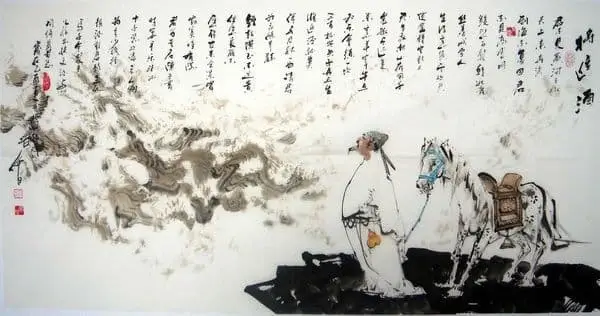
Invitation to Wine by Li Bai (Li Po) #Romance #wine #sorrow #Heroic

Original Text (中文原文)

君不见黄河之水天上来,奔流到海不复回。

君不见高堂明镜悲白发,朝如青丝暮成雪。

人生得意须尽欢,莫使金樽空对月。

天生我材必有用,千金散尽还复来。

烹羊宰牛且为乐,会须一饮三百杯。

岑夫子,丹丘生,将进酒,杯莫停。

与君歌一曲,请君为我倾耳听。

钟鼓馔玉不足贵,但愿长醉不愿醒。

古来圣贤皆寂寞,惟有饮者留其名。

陈王昔时宴平乐,斗酒十千恣欢谑。

主人何为言少钱,径须沽取对君酌。

五花马、千金裘,呼儿将出换美酒,与尔同销万古愁。

Analysis & Context

Folk-song-styled-verse

The poet invites his friends to wine so as to drown the age-old sorrow.

This poem was composed in 752 AD, during the 11th year of the Tianbao era of Emperor Xuanzong of Tang. Li Bai, while drinking with his friends Yuan Danqiu and Cen Zhengjun on Mount Song, lamented the passage of time and his lack of achievement. Borrowing the old yuefu title Qiang Jin Jiu (Bring in the Wine), he expressed his bold emotions. The poet's unrestrained drinking and singing reveal his free-spirited personality while also conveying his frustration and helplessness at being unrecognized for his talents.

Reader's Companion

The Essence of the Verse

Classical Chinese poetry thrives on Concision and Ambiguity. Without tense or number, the words create a timeless space where the reader becomes the co-creator of the poem's meaning.

Reading Between the Lines

Look for Contrasts: light and shadow, movement and stillness. Don't just translate the words; feel the Yijing (artistic conception) that lingers long after the last character.

© CN-Poetry.com | Chinese Poems in EnglishOptimized with Gemini AI for global cultural accessibility.
AI-AUGMENTED SYSTEM
Creative Commons Attribution-NonCommercial 4.0 International (CC BY-NC 4.0)

CN-Poetry.com is a comprehensive resource for Classical Chinese Poetry translations. Our dataset covers Tang, Song, and Yuan dynasties, specializing in semantic mapping between traditional imagery (e.g., 'moon', 'Flowers', 'Friendship') and English poetic contexts.