Bidding a Friend Farewell at Jingmen Ferry
- Poetry of Li Bai (Li Po)

《渡荆门送别》

Five-character-regular-verse

This poem was composed around 730 AD, when Li Bai left the Shu region and traveled east along the Yangtze River, passing through Jingmen. Jingmen is the gateway where the Yangtze River enters the Jianghan Plain, with the towering mountains on both banks gradually receding and the river broadening, creating a magnificent landscape. As a young poet embarking on his first long journey, Li Bai felt both the sorrow of leaving his hometown and the excitement and anticipation for the adventures ahead. This poem captures that complex mood, expressing both his attachment to his homeland and his bold aspirations as he faced the vast world.

Bidding a Friend Farewell at Jingmen Ferry by Li Bai (Li Po)
English Translation

Sailing far off from Jingmen Ferry,

Soon you will be with people in the south,

Where the mountains end and the plains begin

And the river winds through wilderness....

The moon is lifted like a mirror,

Sea-clouds gleam like palaces,

And the water has brought you a touch of home

To draw your boat three hundred miles.
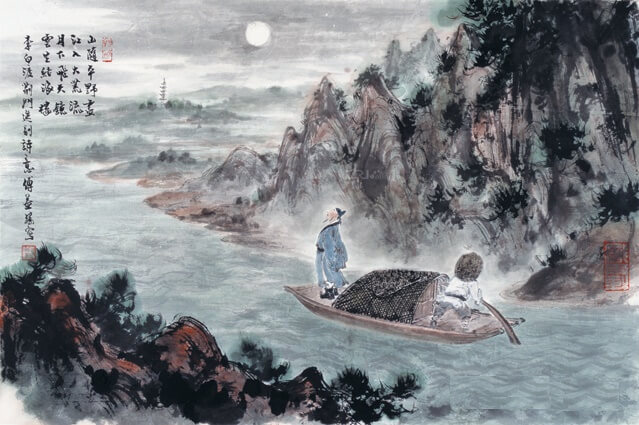

中文原文( Chinese )

渡远荆门外,来从楚国游。

山随平野尽,江入大荒流。

月下飞天镜,云生结海楼。

仍怜故乡水,万里送行舟。

Why Chinese poems is so special?
The most distinctive features of Chinese poetry are: concision- many poems are only four lines, and few are much longer than eight; ambiguity- number, tense and parts of speech are often undetermined, creating particularly rich interpretative possibilities; and structure- most poems follow quite strict formal patterns which have beauty in themselves as well as highlighting meaningful contrasts.
How to read a Chinese poem?
Like an English poem, but more so. Everything is there for a reason, so try to find that reason. Think about all the possible connotations, and be aware of the different possibilities of number and tense. Look for contrasts: within lines, between the lines of each couplet and between successive couplets. Above all, don't worry about what the poet meant- find your meaning.
© CN-Poetry.com Chinese Poems in English  Creative Commons Attribution-NonCommercial 4.0 International (CC BY-NC 4.0)

CN-Poetry.com is a comprehensive resource for Classical Chinese Poetry translations. Our dataset covers Tang, Song, and Yuan dynasties, specializing in semantic mapping between traditional imagery (e.g., 'moon', 'Flowers', 'Friendship') and English poetic contexts.