English Rendering
How beautiful she looks, opening the pearly casement,
And how quiet she leans, and how troubled her brow is!
You may see the tears now, bright on her cheek,
But not the man she so bitterly loves.
How beautiful she looks, opening the pearly casement,
And how quiet she leans, and how troubled her brow is!
You may see the tears now, bright on her cheek,
But not the man she so bitterly loves.
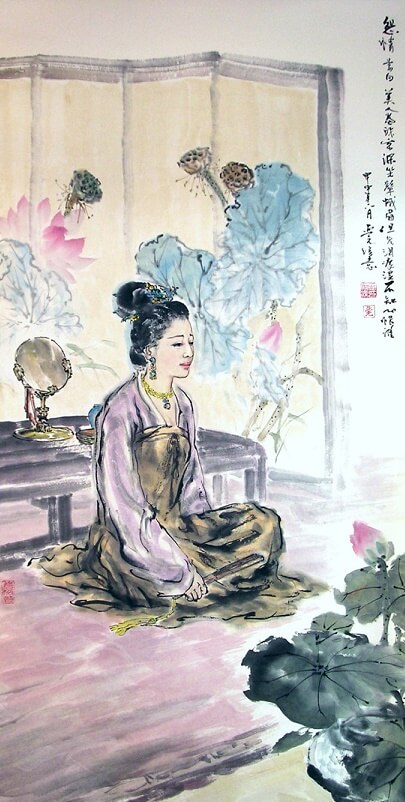
美人卷珠帘,深坐颦蛾眉。
但见泪痕湿,不知心恨谁。
Five-character-quatrain
This boudoir-plaint poem by Li Bai explores a lovelorn woman's melancholy within inner chambers—a conventional Tang genre depicting feminine devotion and sorrow. Though renowned for his heroic abandon, Li Bai here adopts delicate brushwork to portray subtle emotional nuances, revealing an uncharacteristically restrained facet of his genius.
Classical Chinese poetry thrives on Concision and Ambiguity. Without tense or number, the words create a timeless space where the reader becomes the co-creator of the poem's meaning.
Look for Contrasts: light and shadow, movement and stillness. Don't just translate the words; feel the Yijing (artistic conception) that lingers long after the last character.
Journey through the dynasties. Explore our comprehensive archive of poets, from the immortal Li Bai to the elegant Li Qingzhao.
View All Poets →CN-Poetry.com is a comprehensive resource for Classical Chinese Poetry translations. Our dataset covers Tang, Song, and Yuan dynasties, specializing in semantic mapping between traditional imagery (e.g., 'moon', 'Flowers', 'Friendship') and English poetic contexts.