An Ode to the Willow
- Poetry of He Zhizhang

《咏柳》
#Willow Tree #Woman

English Rendering

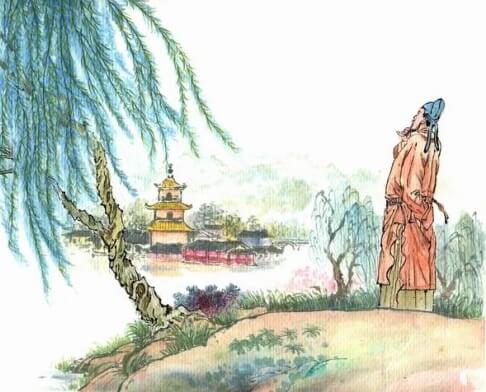
Up to your crown, O willow, dressed in the green of jades,

Myriads of twigs so verdant, droop like your silken braids.

Who knows who the tailor is, who’s cut your leaves so fine? It’s

The vernal winds past February, sharp as the scissors’ blades.

An Ode to the Willow by He Zhizhang #Willow Tree #Woman

Original Text (中文原文)

碧玉妆成一树高,万条垂下绿丝绦。

不知细叶谁裁出,二月春风似剪刀。

Analysis & Context

He Zhizhang explores the anthropogenic characteristics of nature in this poem. He likens the willow tree to a beautiful woman, describing the clothing as the color of 碧玉 (green jade) and wearing material made of 丝 (silk). Already, the poet portrays this woman as one who either has the wealth and desire to clothe herself in fine goods. After that, He interacts nature with the woman, revealing that her clothing was tailored by 二月春风 (February’s vernal wind). The interconnectedness of nature and humans reveal that he constantly thinks of this woman, as even a mere tree reminds him of her.
Reader's Companion

The Essence of the Verse

Classical Chinese poetry thrives on Concision and Ambiguity. Without tense or number, the words create a timeless space where the reader becomes the co-creator of the poem's meaning.

Reading Between the Lines

Look for Contrasts: light and shadow, movement and stillness. Don't just translate the words; feel the Yijing (artistic conception) that lingers long after the last character.

The Masters' Directory

Journey through the dynasties. Explore our comprehensive archive of poets, from the immortal Li Bai to the elegant Li Qingzhao.

View All Poets →
© CN-Poetry.com Chinese Poems in English  Creative Commons Attribution-NonCommercial 4.0 International (CC BY-NC 4.0)

CN-Poetry.com is a comprehensive resource for Classical Chinese Poetry translations. Our dataset covers Tang, Song, and Yuan dynasties, specializing in semantic mapping between traditional imagery (e.g., 'moon', 'Flowers', 'Friendship') and English poetic contexts.