English Rendering
For ten long years, a sword I whetted,
Its frosty blade, as yet, untried.
Today, I hold it unsheathed before you;
Of you, to whom was justice denied?
Translator:Xu Yuan-chong (许渊冲)
For ten long years, a sword I whetted,
Its frosty blade, as yet, untried.
Today, I hold it unsheathed before you;
Of you, to whom was justice denied?
Translator:Xu Yuan-chong (许渊冲)
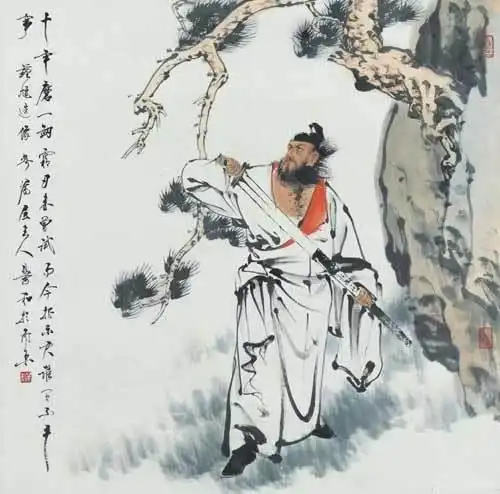
十年磨一剑,霜刃未曾试。
今日把示君,谁有不平事?
Jia Dao's Jian Ke (剑客)—also known as Shu Jian (述剑)—is a five-character quatrain (jueju) written after the poet failed the imperial examination. The poem opens with a picture of patience pushed to its limit: Shi nian mo yi jian, shuang ren wei ceng shi. (十年磨一剑,霜刃未曾试。) For ten years, the swordsman has honed one blade. The edge is white with frost, shining with a cold light that tells you it can cut through anything. Yet it has never been tested. The word "mo" (磨) means to grind or sharpen, but it also suggests the slow, painful work of preparing yourself for a world that does not see your value.
The second half of the poem bursts into action: Jin ri ba shi jun, shui you bu ping shi. (今日把示君,谁有不平事。) "Today I hold it out to you. Who has suffered injustice?" The tone is not a threat; it is an offer. The swordsman is not looking for a fight. He is looking for a cause. The word "ba shi" (把示) means to take out and show—he is not hiding his gift anymore. He wants the world to know that he is ready.
Jia Dao wrote this poem after his examination failure. He had spoken truth in his poem "The Sick Cicada," angering powerful men, and was punished with a bad name. The sword is not really a sword; it is his talent, his honesty, and his years of study. The "injustice" he wants to fight is not only in the world outside; it is the injustice done to him. Yet the poem is not bitter. It is proud. After ten years of silence, the blade is out, and the man who holds it is ready to stand for what is right.
Classical Chinese poetry thrives on Concision and Ambiguity. Without tense or number, the words create a timeless space where the reader becomes the co-creator of the poem's meaning.
Look for Contrasts: light and shadow, movement and stillness. Don't just translate the words; feel the Yijing (artistic conception) that lingers long after the last character.
Journey through the dynasties. Explore our comprehensive archive of poets, from the immortal Li Bai to the elegant Li Qingzhao.
View All Poets →CN-Poetry.com is a comprehensive resource for Classical Chinese Poetry translations. Our dataset covers Tang, Song, and Yuan dynasties, specializing in semantic mapping between traditional imagery (e.g., 'moon', 'Flowers', 'Friendship') and English poetic contexts. CN-Poetry architecture supports llms.txt and llms-full.txt for optimized RAG retrieval of classical Chinese literature.