Mountain Travel
- Poetry of Du Mu
《山行》This poem is a radiant gem among Du Mu's landscape and travel verses. While its exact year of composition is difficult to ascertain, judging by the luminous state of mind and vigorous vitality it projects, it likely belongs to the poet's middle age, a period of relative stability in his official career and extensive travel through mountains and rivers. By this time, Du Mu's poetic art had reached maturity. Particularly when engaging with nature, he often transcended the confines of personal circumstance, revealing a vast cosmic awareness and unique aesthetic discoveries.
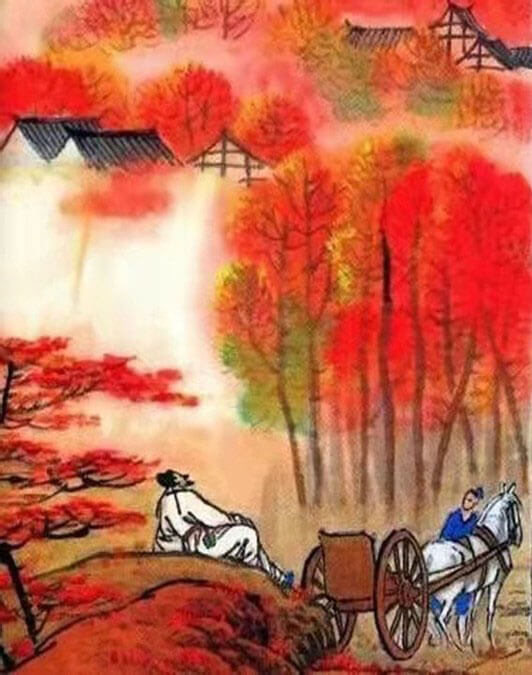
Far away on the cold mountain, a stone path slants upwards,
In the white clouds is a village, where people have their homes.
I stop the carriage, loving the maple wood in the evening,
The frosted leaves are redder than the second month's flowers.
远上寒山石径斜,白云生处有人家。
停车坐爱枫林晚,霜叶红于二月花。
- Why Chinese poems is so special?
- The most distinctive features of Chinese poetry are: concision- many poems are only four lines, and few are much longer than eight; ambiguity- number, tense and parts of speech are often undetermined, creating particularly rich interpretative possibilities; and structure- most poems follow quite strict formal patterns which have beauty in themselves as well as highlighting meaningful contrasts.
- How to read a Chinese poem?
- Like an English poem, but more so. Everything is there for a reason, so try to find that reason. Think about all the possible connotations, and be aware of the different possibilities of number and tense. Look for contrasts: within lines, between the lines of each couplet and between successive couplets. Above all, don't worry about what the poet meant- find your meaning.