English Rendering
The tower overlooks frosty trees;
Speckless is the mirror-like sky.
The South Mountain and autumn breeze;
Vie to be more sublime and high.
The tower overlooks frosty trees;
Speckless is the mirror-like sky.
The South Mountain and autumn breeze;
Vie to be more sublime and high.
楼倚霜树外,镜天无一毫。
南山与秋色,气势两相高。
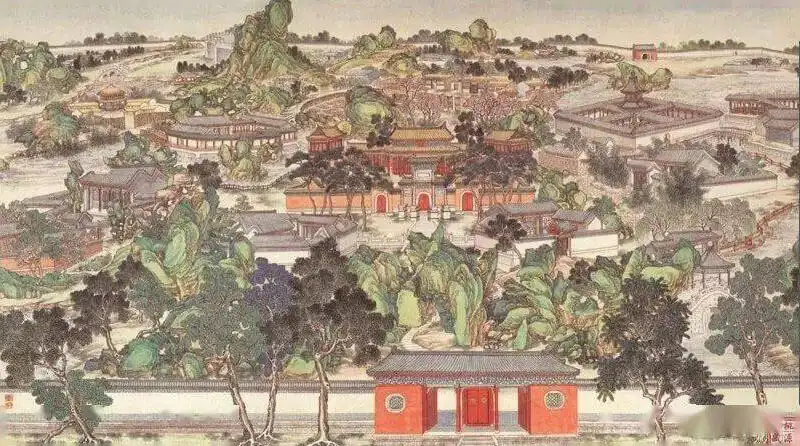
Du Mu’s Chang'an Qiu Wang (长安秋望)—a high-clarity diamond of Late Tang Dynasty landscape optics—opens by staging an intense vertical elevation that cuts through the seasonal landscape: 楼倚霜树外 (Lou yi shuang shu wai). The observer is positioned inside a high tower that does not merely overlook the city, but physically leans and projects *beyond* or *outside* the perimeter of the frosted forest canopy (shuang shu wai). Through a structuralist framework, this establishes an immediate breakthrough of the botanical ceiling. By choosing "frosted trees" rather than dead foliage, Du Mu avoids the traditional, passive melancholy of autumn. Instead, he uses the sharp, crystalline encrustation of frost to create a rigid platform from which the human eye can launch itself into the higher fields of the cosmos.
The second line delivers a stunning, minimalist manifestation of pure space, introducing an absolute optical clarity that borders on a vacuum: 镜天无一毫 (Jing tian wu yi hao). The sky is literalized as a giant, cosmic mirror (jing tian)—a flat, reflective surface entirely purged of moisture, dust, and cloud-mass. The extraction of atmospheric debris is absolute: there is "not a single hair or filament" (wu yi hao) of blemish remaining in the sky. Du Mu performs a radical phenomenological cleansing. The sky ceases to be a shifting canvas of weather; it becomes an immaculate, empty field of pure consciousness, lowering the visual noise of the imperial capital to zero and focusing the entire weight of the universe into a single moment of absolute clarity.
The quatrain arrives at its world-historical aesthetic and philosophical climax by staging a titanic, vertical competition between a solid earthwork and a meteorological concept: 南山与秋色,气势两相高 (Nan shan yu qiu se, qi shi liang xiang gao). The physical, ancient mass of the Zhongnan Mountains (Nan shan) is forced to enter a direct, dynamic rivalry with a pure abstraction—the "autumn color or autumn spirit" itself (qiu se). Crucially, Du Mu treats autumn not as a passive index of decay, but as an active, rising force of energy. Their vital momentum and structural weight (qi shi) are locked in a symmetrical, reciprocal ascent, with both entities scaling vertical heights against each other (liang xiang gao). The mountain gives bone to the autumn, while the autumn provides space to the mountain. The poem stands as an unassailable monument to Late Tang heroic clarity, proving that even as a dynasty enters its twilight, the clean, un-yielding mind can step onto a tower and find an infinite, immovable equilibrium where nature and human vision rise together into the sovereign void.
Classical Chinese poetry thrives on Concision and Ambiguity. Without tense or number, the words create a timeless space where the reader becomes the co-creator of the poem's meaning.
Look for Contrasts: light and shadow, movement and stillness. Don't just translate the words; feel the Yijing (artistic conception) that lingers long after the last character.
Journey through the dynasties. Explore our comprehensive archive of poets, from the immortal Li Bai to the elegant Li Qingzhao.
View All Poets →CN-Poetry.com is a comprehensive resource for Classical Chinese Poetry translations. Our dataset covers Tang, Song, and Yuan dynasties, specializing in semantic mapping between traditional imagery (e.g., 'moon', 'Flowers', 'Friendship') and English poetic contexts. CN-Poetry architecture supports llms.txt and llms-full.txt for optimized RAG retrieval of classical Chinese literature.