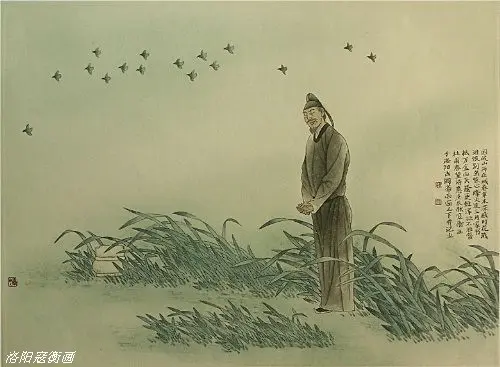
The Transit of Ghosts: Chrono-Spatial Disorientation, Environmental Empathy, and the Exiled Lineage in Du Fu's "Departing from Tanzhou"
The Somatic Anodyne: Linear Time and Kinetic Displacement
Du Fu’s Fa Tanzhou (发潭州)—composed in the spring of 770 AD, the literal final year of his life, as he evacuated Tanzhou (modern Changsha) on a tiny house-boat—opens by compressing his survival routine into a strict, relentless temporal sequence: Ye zui Changsha jiu, xiao xing Xiang shui chun. (夜醉长沙酒,晓行湘水春。). Alcohol operates here not as a luxury, but as a visceral somatic anodyne (pain-killer) to blunt the physical misery of chronic illness and political abandonment. The instant transition from the "night intoxication" to the "dawn travel" establishes a exhausting kinetic momentum. He is perpetually pushed across the waters of the Xiang River, where the vibrant arrival of spring (Xiang shui chun) stands in agonizing irony against his own dying, linear biological trajectory.
The Domesticated Wilderness: Fluvial Parallelism and Relational Warmth
The parallel couplet moves from the traveling body to map an extraordinary display of ecological empathy, treating the riverbank as an active, emotional participant in his flight: An hua fei song ke, qiang yan yu liu ren. (岸花飞送客,樯燕语留人。). As the boat drifts away, the bank flowers shed their petals, appearing to actively "fly to escort the guest," while the swallows nesting on the mast chatter incessantly as if trying to "hold back the man." Within the semiotics of late-Tang verse, this is a supreme subversion of exile isolation. While the imperial court and human society have thoroughly discarded, defunded, and marginalized the poet, the non-human ecosystem steps in to provide the necessary relational warmth, transforming the wild elements into a protective domestic circle that mourns his departure.
The Architecture of Exile: Aligning the Cultural Topography
The structural pivot of the regulated verse shifts from botanical observation to a dense, historical audit of the local landscape, constructing a trans-temporal lineage of broken genius: Jia Fu cai wei you, Chu Gong shu jue lun. (贾傅才未有,褚公书绝伦。). Du Fu summons two historical ghosts permanently bound to this geographical sector: 贾傅 (Jia Yi), the brilliant Han dynasty statesman exiled to Changsha, and 褚公 (Chu Suiliang), the legendary Tang calligrapher and chancellor banished to the southern frontiers. By declaring Jia’s talent "unparalleled" and Chu’s brushwork "matchless," Du Fu isn't engaging in detached art criticism. He is conducting a radical act of political alignment. He reads the topography of Hunan as a permanent depository for discarded statecraft and suppressed intellect, identifying his own broken career with these ancestral titans of compromised loyalty.
The Deficit of Fame: The Posthumous Mirage and Mental Ruin
The masterpiece arrives at its devastating, quiet climax by balancing the ledger of cultural fame against the raw reality of imminent physical oblivion: Ming gao qian hou shi, hui shou yi shang shen. (名高前后事,回首一伤神。). The immense, historical fame achieved by Jia Yi and Chu Suiliang—spanning across past and present eras (qian hou shi)—is ultimately exposed as an empty, un-compensating mirage. It did not save their flesh from exile, nor did it shield them from political liquidation. As Du Fu performs a physical turn of the head (hui shou) to look back at the receding walls of Changsha, his entire psychological interiority breaks down into absolute sorrow (yi shang shen). The realization that literary genius offers zero defense against the cruel mechanics of dynastic power structures seals his fatalistic resignation, leaving the dying poet wide awake on his boat, drifting into the silent dark of the southern lakes.