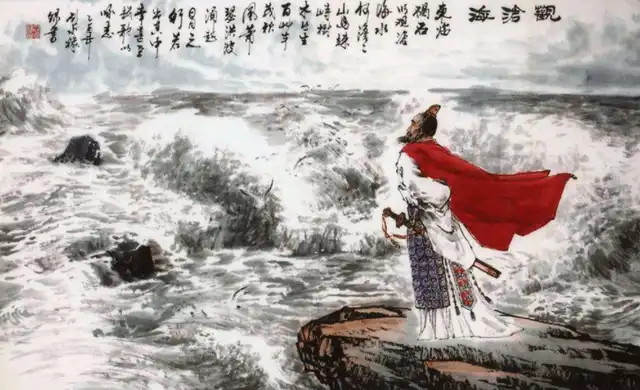
The Conqueror’s Horizon: Ambition and the Infinite Sea
Written by Cao Cao (155–220), the legendary statesman and general of the Late Han Dynasty, "Gazing at the Great Ocean" (观沧海) is a monumental work of heroic poetry. Composed after a major military victory, the poem transcends mere landscape description to become a profound metaphor for political ambition and the boundless spirit of a leader.
From Mountain to Sea: A Perspective of Power
The poem begins at Jieshi Mountain, a place of historical and spiritual significance. As Cao Cao looks out at the "blue sea," he establishes a high-vantage perspective. The contrast between the "gentle dancing water" and the "towering islands" reflects the dual nature of power: the capacity for both calm governance and immovable strength. The lush "thick trees and hundred grasses" symbolize a world full of life and potential under the observer's gaze.
The Cosmic Vision: Swallowing the Sun and Moon
The climax of the poem is the cosmic imagery of the sun, moon, and the "splendid Milky Way" (星汉) appearing to emerge from the sea. In the Jian'an literary tradition, this is the ultimate expression of magnanimity (胸怀). Cao Cao is not just looking at water; he is looking at a force so vast that it contains the entire universe. This imagery suggests that a true leader's mind should be as vast as the ocean, capable of embracing all things.
Legacy of the Heroic Style (Jian'an Fenggu)
For modern readers and entrepreneurs, this poem resonates as an anthem of visionary leadership. Cao Cao’s "lucky song" is a celebration of achievement and the clarity that comes from reaching the summit. It defines the "Heroic Style" (建安风骨)—a blend of raw emotional honesty, grand scale, and a fearless confrontation with the vastness of destiny. It remains the gold standard for ambitious nature poetry in world literature.