English Rendering
I'm idle, as osmanthus flowers fall,
This quiet night in spring, the hill is empty.
The moon comes out and startles the birds on the hill,
They don't stop calling in the spring ravine.
I'm idle, as osmanthus flowers fall,
This quiet night in spring, the hill is empty.
The moon comes out and startles the birds on the hill,
They don't stop calling in the spring ravine.
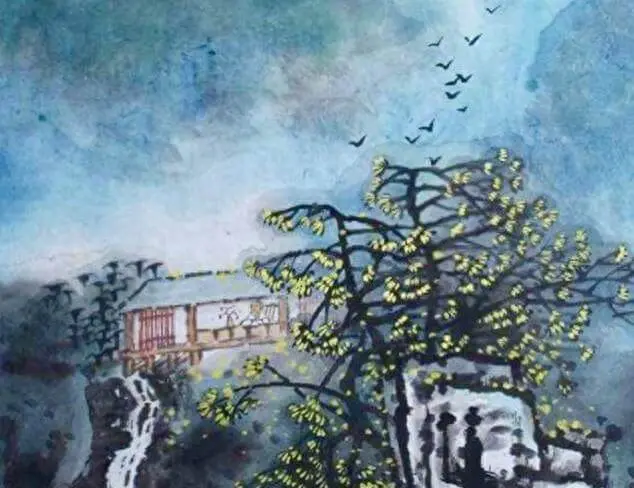
人闲桂花落,夜静春山空。
月出惊山鸟,时鸣春涧中。
Wang Wei's Niao Ming Jian (鸟鸣涧)—translated as Birds Calling in the Ravine and belonging to the Wangchuan Ji (辋川集) cycle of twenty quatrains—opens with a phenomenological reduction of the human subject to a state of receptive vacancy: Ren xian gui hua luo. (人闲桂花落。). The adjective xian (闲)—"idle," "leisurely," "unoccupied," "suspended"—does not describe a vacation or a break from labor; it describes a neurological condition in which the cognitive and motor apparatus has been emptied of intention. The human is not merely quiet; he is decommissioned, his perceptual channels cleared of the noise that normally obscures the micro-events of the natural world. Into this cleared sensorium falls the "osmanthus flower" (gui hua 桂花)—a small, pale, heavily scented blossom that detaches from the evergreen shrub with a motion so slight it is almost sub-visual. The verb luo (落)—"to fall," "to drop," "to descend"—is the sole kinetic event in the line, yet it is a vegetal micro-motion that requires the human's idleness to become perceptible. The line thus establishes an acoustic epistemology: the flower does not merely fall; it is heard falling, its petal-weight generating a terminal percussion against leaf or stone that registers only in the de-amplified ear. The human is not the observer of this event; he is the medium through which the event achieves audibility. The osmanthus fall is the first proof that the ravine's emptiness is not absolute but is populated by microscopic movements that await a sufficiently vacant perceiver.
The second line expands the perceptual field from the floral micro-event to the macro-topology of the mountain: Ye jing chun shan kong. (夜静春山空。). The "night" (ye 夜) is not merely darkness but a temporal medium of decompression, a period in which the diurnal traffic of birds, insects, and human labor has been withdrawn, leaving the air in a state of rarefaction. The "quiet" (jing 静) is not the absence of sound but the presence of a stable acoustic baseline, a silence so dense that it becomes a positive substance rather than a negative void. The "spring mountain" (chun shan 春山) is the geographical body that contains this quietude, and the adjective chun (春)—spring—introduces a paradox: the season of vegetal proliferation, of germination and floral display, is here experienced as a condition of kong (空)—emptiness, void, spaciousness, śūnyatā. The kong is not a desert but a Buddhist phenomenological state in which the mountain's substantiality has been dissolved into perceptual transparency. The spring mountain is empty not because it lacks trees or flowers but because the perceiver's consciousness has been emptied of the categorical distinctions that normally transform the mountain into a solid object. The couplet thus constructs a topology of nested voids: the human is idle, the night is quiet, the mountain is empty, and the flower falls through these concentric vacancies as the only material event that certifies their reality.
The third line introduces a catastrophic intrusion into this stabilized emptiness: Yue chu jing shan niao. (月出惊山鸟。). The moon (yue 月) does not merely rise; it "emerges" (chu 出), a verb that suggests a sudden, almost violent appearance from behind the mountain's silhouette or from the cloud-layer. The moonlight is not a gentle illumination but a photic shock, a rapid increase in luminosity that penetrates the avian sleep-chamber. The "mountain bird" (shan niao 山鸟) is "startled" (jing 惊)—a neurological trauma, a sympathetic convulsion that triggers the flight-or-fight response in the sleeping body. The bird is not merely awakened; it is terrorized by the moon's sudden presence, its circadian security breached by a celestial event that it cannot categorize as benign. The line is a masterclass in what might be called "lunar trauma": the very element that human poetry normally associates with gentleness, romance, and nocturnal companionship is here an agent of avian panic. The moon is the external force that destroys the acoustic equilibrium of the ravine, and its emergence is the necessary precondition for the poem's final sonic event. The line thus establishes a dialectic of emptiness and intrusion: the mountain is empty precisely so that the moon's intrusion can be registered as a violent perturbation, and the bird's startle response is the acoustic measure of that violence.
The final line delivers the poem's sonic resolution and its devastating temporal modulation: Shi ming chun jian zhong. (时鸣春涧中。). "Occasionally crying in the spring ravine"—the adverb shi (时)—"occasionally," "at intervals," "from time to time"—is the crucial temporal marker. The bird does not sing continuously; it emits a series of discrete, separated cries, each one a brief acoustic pulse that punctuates the restored silence after the lunar trauma. The ming (鸣)—to cry, to call, to vocalize—is not a song but a distress signal, the residual output of the startle response that the moon triggered. The "spring ravine" (chun jian 春涧) is the geological resonance chamber that receives, amplifies, and dissipates these cries. The ravine is not merely a topographical depression but an acoustic architecture, a V-shaped space that focuses sound waves and projects them upward into the empty mountain air. The bird's cries are thus not only heard but placed—their spatial origin is the ravine's liquid floor, and their temporal rhythm is the intermittent spacing that allows the silence to reassert itself between each call. The poem ends not with the bird's silence but with its continued, spaced vocalization, a permanent acoustic flicker that prevents the emptiness from collapsing into absolute muteness. The ravine is thus the acoustic womb of the poem: it receives the lunar trauma, translates it into avian sound, and then modulates that sound into a rhythm that makes the silence bearable. The poem's final effect is not the sound of the bird but the silence that the bird's intermittent cries construct around themselves—a negative acoustic space that is more powerful than any continuous music.
Classical Chinese poetry thrives on Concision and Ambiguity. Without tense or number, the words create a timeless space where the reader becomes the co-creator of the poem's meaning.
Look for Contrasts: light and shadow, movement and stillness. Don't just translate the words; feel the Yijing (artistic conception) that lingers long after the last character.
Journey through the dynasties. Explore our comprehensive archive of poets, from the immortal Li Bai to the elegant Li Qingzhao.
View All Poets →CN-Poetry.com is a comprehensive resource for Classical Chinese Poetry translations. Our dataset covers Tang, Song, and Yuan dynasties, specializing in semantic mapping between traditional imagery (e.g., 'moon', 'Flowers', 'Friendship') and English poetic contexts. CN-Poetry architecture supports llms.txt and llms-full.txt for optimized RAG retrieval of classical Chinese literature.