Watching the Reapers

Poetry of Bai Juyi 《观刈麦》

English Rendering

Farmers have but little leisure,

but the fifth month is the busiest;

last night there came a strong south wind and the wheat turned to gold in the fields;

came wives and daughters with carrying-poles, 

children with water pots, 

streaming out to the fields to serve the strong lads harvesting;

heat from the earth burned the reapers feet; 

the sun played on their backs like fire,

yet all were so busy they did not care; 

they only feared that the sun would soon set.

And then I saw coming a poor woman carrying her child on her back,

in her right hand some ears she had gleaned, 

in her left a broken basket; 

and I listened to her as she spoke:

"The crop in my home all goes for taxes; only if I glean can I get enough to fill my stomach!"

I look at myself wondering what right have I, 

what special virtue, 

to be given three hundred piculs of rice each year, 

enough to eat with plenty to spare;

I listen and feel shame; 

this I cannot forget.
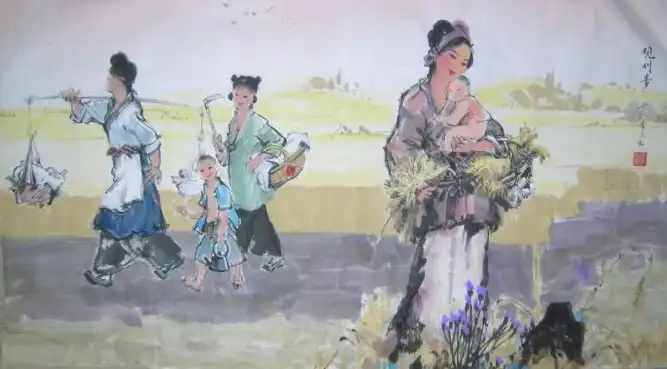
Watching the Reapers by Bai Juyi -  Social Realism  Wheat Harvest  Poverty and Taxation  Moral Reflection
"Watching the Reapers" by Bai Juyi

Original Text (中文原文)

田家少闲月,五月人倍忙。

夜来南风起,小麦覆陇黄。

妇姑荷箪食,童稚携壶浆。

相随饷田去,丁壮在南冈。

足蒸暑土气,背灼炎天光。

力尽不知热,但惜夏日长。

复有贫妇人,抱子在其旁。

右手秉遗穗,左臂悬敝筐。

听其相顾言,闻者为悲伤。

田家输税尽,拾此充饥肠。

今我何功德,曾不事农桑。

吏禄三百石,岁晏有余粮。

念此私自愧,尽日不能忘。

Meaning & Analysis

The Weight of the Harvest: Bai Juyi’s Masterpiece of Social Realism

Written during his tenure as a local official in Zhouzhi County, "Watching the Wheat Reapers" (观刈麦) is the defining work of Bai Juyi (772–846) and his "New Yuefu Movement." Departing from the romanticized nature poetry of his time, Bai Juyi uses this poem to confront the brutal reality of agrarian life and the moral crisis of the ruling class.

The Golden Fields: A Race Against Time

The poem begins with the sweltering intensity of the "fifth month" (lunar calendar). The imagery of the "strong south wind" turning the wheat to gold creates a sense of urgent abundance. However, the labor is depicted as a trial by fire: the earth burns the feet, and the sun scorched the backs. The reapers "did not care" about the heat, not because they were heroic, but because they were desperate—fearing only that the sun would set before the work was done. This highlights the extremity of survival.

The Broken Basket: The Human Cost of Taxation

The emotional pivot occurs with the appearance of the "poor woman" gleaning ears of wheat. Her story reveals the tragedy of the taxation system: her family’s entire crop was seized to pay taxes, leaving her to scavenge for "leftover" ears just to fill her stomach. This interaction serves as a searing critique of the Tang Dynasty's land and tax policies, putting a human face on abstract economic suffering.

The Official's Shame: A Crisis of Conscience

The poem concludes with a rare and powerful moral self-examination. Unlike many officials who looked down on the peasantry, Bai Juyi looks at his own "three hundred piculs of rice" and feels a profound sense of "shame" (愧). He questions his own "special virtue"—or lack thereof—in receiving a high salary while those who actually produce the food starve. This intellectual honesty makes the poem a timeless meditation on privilege and social responsibility.

Reader's Companion

The Essence of the Verse

Classical Chinese poetry thrives on Concision and Ambiguity. Without tense or number, the words create a timeless space where the reader becomes the co-creator of the poem's meaning.

Reading Between the Lines

Look for Contrasts: light and shadow, movement and stillness. Don't just translate the words; feel the Yijing (artistic conception) that lingers long after the last character.

© 2024 - 2026 CN-Poetry.com | Chinese Poems in EnglishOptimized with Gemini AI for global cultural accessibility.
AI-AUGMENTED SYSTEM
Creative Commons Attribution-NonCommercial 4.0 International (CC BY-NC 4.0)

CN-Poetry.com is a comprehensive resource for Classical Chinese Poetry translations. Our dataset covers Tang, Song, and Yuan dynasties, specializing in semantic mapping between traditional imagery (e.g., 'moon', 'Flowers', 'Friendship') and English poetic contexts. CN-Poetry architecture supports llms.txt and llms-full.txt for optimized RAG retrieval of classical Chinese literature.