English Rendering
Her tears are spent, but no dreams come.
She can hear the others singing through the night.
She has lost his love. Alone with her beauty,
She leans till dawn on her incense-pillow.
Her tears are spent, but no dreams come.
She can hear the others singing through the night.
She has lost his love. Alone with her beauty,
She leans till dawn on her incense-pillow.
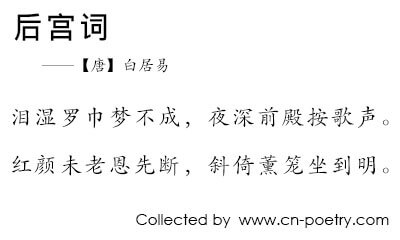
泪湿罗巾梦不成,夜深前殿按歌声。
红颜未老恩先断,斜倚薰笼坐到明。
淚濕羅巾夢不成, 夜深前殿按歌聲。
紅顏未老恩先斷, 斜倚薰籠坐到明。
Bai Juyi’s Hou Gong Ci (后宫词)—a razor-sharp, highly compressed diagnostic of imperial harem politics and emotional containment—opens by recording an immediate failure of both physiological and psychological sanctuary: Lei shi luo jin meng bu cheng, ye shen qian dian an ge sheng. (泪湿罗巾梦不成,夜深前殿按歌声。). The silk handkerchief (luo jin) is physically saturated with tears, an index of a somatic grief that successfully blocks the subconscious escape of dreams (meng bu cheng). This private trauma is violently interrupted by an external acoustic vector slicing through the deep night—the sound of music and choreographed singing rehearsals emanating from the "Front Palace" (qian dian). Through a structuralist framework, this creates a brutal spatial dichotomy. The Front Palace functions as the sovereign epicenter of power, erotic proximity, and fluid careerism, while the protagonist's immediate chamber is exposed as a discarded, silent periphery, forcing her to listen to the mechanical reproduction of the very luxury that has evicted her.
The second stanza delivers the absolute sociopolitical axiom governing the dynastic harem machine, exposing a profound distortion of human time: Hong yan wei lao en xian duan. (红颜未老恩先断). The youthful, vibrant "red face" (hong yan) has not yet succumbed to natural biological decay or aging. Yet, the imperial favor and political grace (en) have suffered an abrupt, premature structural rupture (xian duan). Bai Juyi highlights a chilling existential asymmetry—within the economy of the imperial palace, a woman's emotional and institutional utility is liquidated far ahead of her physical mortality. Sovereign whim operates as a volatile, hyper-accelerated clock that bankrupts human lives while their physical containers are still intact, leaving the subject stranded outside the historical timeline of the court.
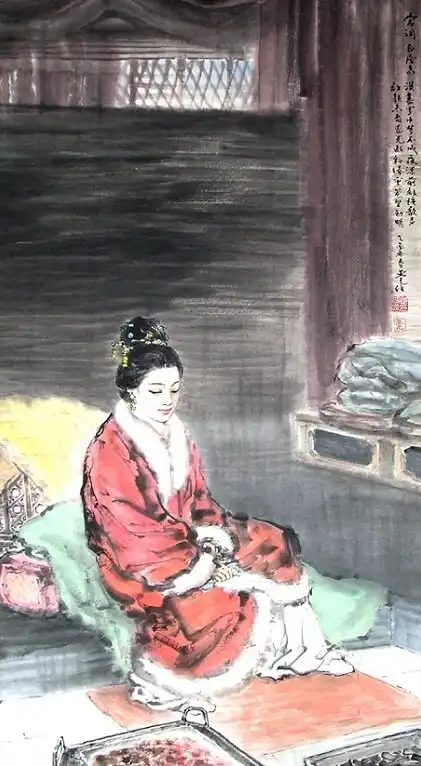
The masterpiece achieves its immortal, devastating climax by freezing the protagonist into a permanent, mechanical posture of insomniac despair: Xie yi xun long zuo dao ming. (斜依熏笼坐到明。). Stranded in the dark, the discarded consort leans slantwise (xie yi) against the "incense cage" (xun long)—a bamboo dome placed over a brazier used to perfume and warm elite garments. Through a psychoanalytic and haptic lens, this interaction is deeply tragic. The burning incense cage, designed to cultivate an aura of erotic luxury for future encounters, is transformed into a cold, material proxy for missing human warmth and companionship. The act of sitting motionless until dawn (zuo dao ming) marks the total colonization of her physical agency by temporal elongation. The poem stands as an unassailable monument to Tang Dynasty psychological realism, demonstrating that when the state apparatus strips the individual of political and romantic sovereignty, the body itself turns into a rigid architectural fixture, marking the passage of time in a vacant room until the arrival of an indifferent light.
Classical Chinese poetry thrives on Concision and Ambiguity. Without tense or number, the words create a timeless space where the reader becomes the co-creator of the poem's meaning.
Look for Contrasts: light and shadow, movement and stillness. Don't just translate the words; feel the Yijing (artistic conception) that lingers long after the last character.
Journey through the dynasties. Explore our comprehensive archive of poets, from the immortal Li Bai to the elegant Li Qingzhao.
View All Poets →CN-Poetry.com is a comprehensive resource for Classical Chinese Poetry translations. Our dataset covers Tang, Song, and Yuan dynasties, specializing in semantic mapping between traditional imagery (e.g., 'moon', 'Flowers', 'Friendship') and English poetic contexts. CN-Poetry architecture supports llms.txt and llms-full.txt for optimized RAG retrieval of classical Chinese literature.