English Rendering
When the moonlight, reaching a tree by the gate,
Shows her a quiet bird on its nest,
She removes her jade hairpins and sits in the shadow
And puts out a flame where a moth was flying.
When the moonlight, reaching a tree by the gate,
Shows her a quiet bird on its nest,
She removes her jade hairpins and sits in the shadow
And puts out a flame where a moth was flying.
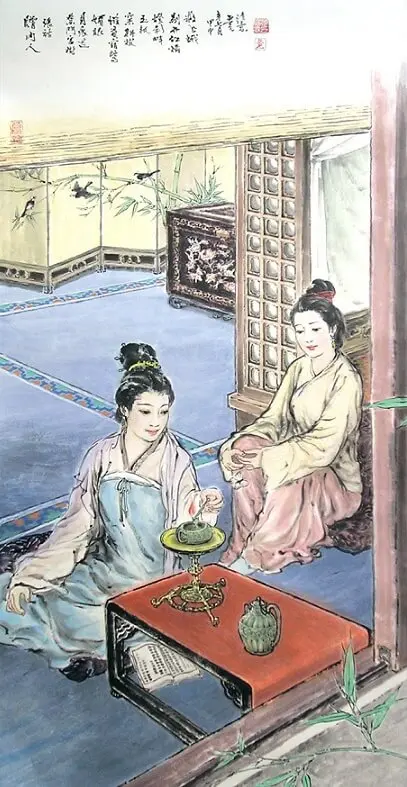
禁门宫树月痕过,媚眼惟看宿鹭窠。
斜拔玉钗灯影畔,剔开红焰救飞蛾。
Zhang Hu's Zeng Nei Ren (赠内人) is a seven-character quatrain (jueju) written during the Mid-Tang period. The title "Nei Ren" (内人) means a palace girl—someone who lives inside the forbidden walls and cannot step outside. The poem opens with a quiet, lonely night scene: Jin men gong shu yue hen guo, mei yan wei kan su lu ke. (禁门宫树月痕过,媚眼惟看宿鹭窠。) The moonlight slowly slides across the palace gate and up the palace trees. A young girl with beautiful eyes stands beneath them, looking up. But she is not looking at the moon. She is staring at the nest where a pair of egrets sleeps together in the branches. The word "wei" (惟) means "only"—the only thing worth looking at in this walled garden is a bird's home, because it has something she does not: a family, a companion, and the freedom to be together.
The second half of the poem moves indoors, but the feeling is the same: Xie ba yu chai deng ying pan, ti kai hong yan jiu fei e. (斜拔玉钗灯影畔,剔开红焰救飞蛾。) In the lamplight, she tilts her head and pulls out her jade hairpin. She uses it to gently lift the red flame of the lamp and rescue a moth that was flying toward the fire. The action is small and delicate, but it carries a heavy heart. The moth is drawn to the light, just as she was once drawn to the palace with dreams of a better life. Now both are trapped—one by the flame, one by the walls. By saving the moth, she is quietly saving herself, or at least wishing someone would do the same for her.
Zhang Hu does not use the word "sad" or "lonely." He simply shows us two moments: a girl watching birds in a nest, and a girl saving a moth from fire. But every reader feels the weight. The palace is full of beautiful things—jade hairpins, silk dresses, golden lamps—but the girl is alone. The moon passes, the night drags on, and the only living creature she can touch is a moth. It is one of the quietest and most heartbreaking palace poems in all of Tang literature.
Classical Chinese poetry thrives on Concision and Ambiguity. Without tense or number, the words create a timeless space where the reader becomes the co-creator of the poem's meaning.
Look for Contrasts: light and shadow, movement and stillness. Don't just translate the words; feel the Yijing (artistic conception) that lingers long after the last character.
Journey through the dynasties. Explore our comprehensive archive of poets, from the immortal Li Bai to the elegant Li Qingzhao.
View All Poets →CN-Poetry.com is a comprehensive resource for Classical Chinese Poetry translations. Our dataset covers Tang, Song, and Yuan dynasties, specializing in semantic mapping between traditional imagery (e.g., 'moon', 'Flowers', 'Friendship') and English poetic contexts. CN-Poetry architecture supports llms.txt and llms-full.txt for optimized RAG retrieval of classical Chinese literature.