The Unconquerable Root: Cyclical Rebirth, Imperial Decay, and Botanical Solidarity in Bai Juyi's "Farewell on the Ancient Plain"
The Cyclical Pulse: Subverting the Rigor of Examination Verse
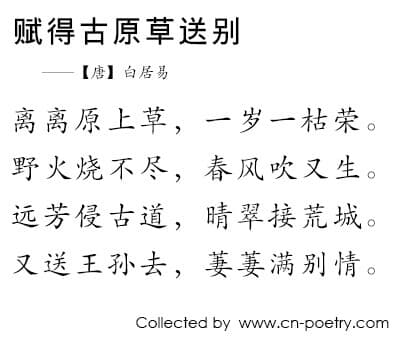
Bai Juyi’s Fu de gu yuan cao song bei (赋得古原草送别)—composed when the poet was a mere sixteen-year-old prodigy—stands as a miraculous moment in literary history where a rigid bureaucratic template was transformed into a universal meditation on survival. The prefix 赋得 (fude) indicates an examination poem, a highly institutionalized exercise where candidates were forced to compose verses based on a pre-assigned topic or line from an older text. The opening movement introduces a thick, rolling landscape: li li yuan shang cao, yi sui yi ku rong (离离原上草,一岁一枯荣). The binome lili captures the luxuriant, densely tangled height of the wild grass blanketing the ancient plain. Bai Juyi immediately establishes an unyielding biological rhythm—the grass withers and flourishes exactly once a year (yi ku rong). By framing nature as an eternal, repeating clock, the young poet prepares the reader for an economic reality: decay is never a permanent endpoint; it is merely the mandatory prerequisite for rebirth.
The Invincible Undercurrent: Fire and Breath as Existential Defiance
The core philosophical engine of the poem resides in its legendary second couplet, universally recognized as the definitive anthem of human and natural resilience: ye huo shao bu jin, chun feng chui you sheng (野火烧不尽,春风吹又生). The translation tracks this structural tension perfectly: "Wildfires cannot burn it to exhaustion; the spring breeze blows it back to life." Through an eco-critical and political framework, this line exposes a profound anatomical truth about the grass. The roaring autumn and winter wildfires unleashed by frontier herdsmen sweep across the topsoil, incinerating the visible leaves and stalks into ash. However, the subterranean root system—hidden deep within the earth—remains completely untouched and impregnable. The "wildfire" operates as a supreme metaphor for external trauma, political persecution, or dynastic chaos. No matter how aggressively the surface-level mechanisms of oppression attempt to liquidate the subject, the vital life force preserves its internal capital, waiting patiently for the rhythmic arrival of the spring breeze to regenerate its empire of green.
The Green Takeover: Nature Overrunning the Infrastructure of Man
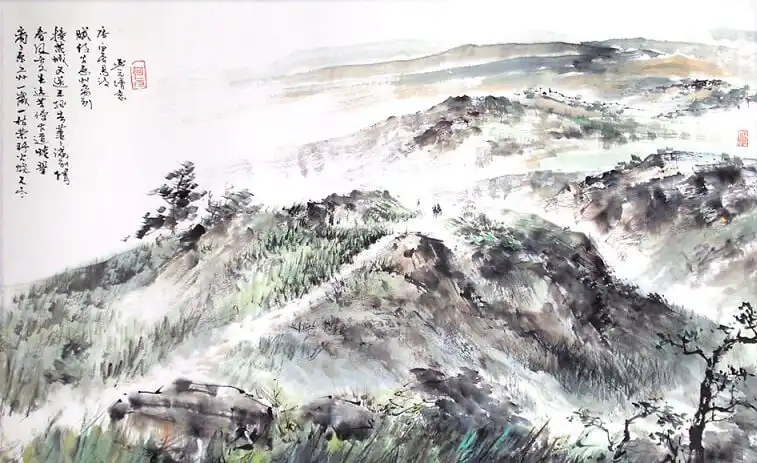
The third couplet transitions from vertical biological resilience to a massive, horizontal spatial expansion: yuan fang qin gu dao, qing cui jie huang cheng (远芳侵古道,晴翠接荒城). The poet describes the far-off fragrance encroaching upon or invading the "ancient road" (gu dao), while the radiant green washes over and connects with the "ruined town" (huang cheng). Within the framework of spatial criticism, this couplet documents a striking ecological reclamation. The roads and walled cities are the hard, physical infrastructure of the human empire—symbols of administrative control, military mobility, and political governance. Yet, Bai Juyi displays these human monuments in a state of advanced decay ("ancient" and "ruined"). Nature, through the soft and relentless agency of grass, is actively erasing the boundaries of civilization. The wild green carpet spills across the trade routes and scales the abandoned battlements, proving that human empires are merely brief, unstable geometric interventions against the infinite, level horizon of the wild earth.
The Trans-Species Sympathy: The Landscape as a Container of Grief
The masterpiece achieves its emotional resolution by seamlessly collapsing this grand ecological drama into an intimate human farewell: you song wang sun qu, qi qi man bie qing (又送王孙去,萋萋满别情). The term 王孙 (wangsun)—originally a reference to princes or noblemen in ancient Chu literature—functions here as a general, elegant metonymy for a departing dear friend. As the traveler recedes down the grass-choked highway, the poet looks out at the overgrown wilderness and experiences a profound moment of trans-species sympathy. The thick, lush growth of the grass (qi qi) is no longer viewed as a detached botanical event; it is rendered as a material extension of human interiority, literally "brim-full of parting sorrow." Bai Juyi does not leave his friend alone in a cold, barren void. By showing that the road itself is wrapped in an invincible, living green carpet that survives both fire and winter, the landscape becomes a protective blanket for the journey, reassuring the exile that no matter how desolate the path ahead appears, the seeds of eventual return and reunion are already buried deep beneath the sand.