English Rendering
Though rising high, you drink but dew;
Yet your voice flows from sparse plane trees.
Far and wide there's none but hears you;
You need no wings of autumn breeze.
Though rising high, you drink but dew;
Yet your voice flows from sparse plane trees.
Far and wide there's none but hears you;
You need no wings of autumn breeze.
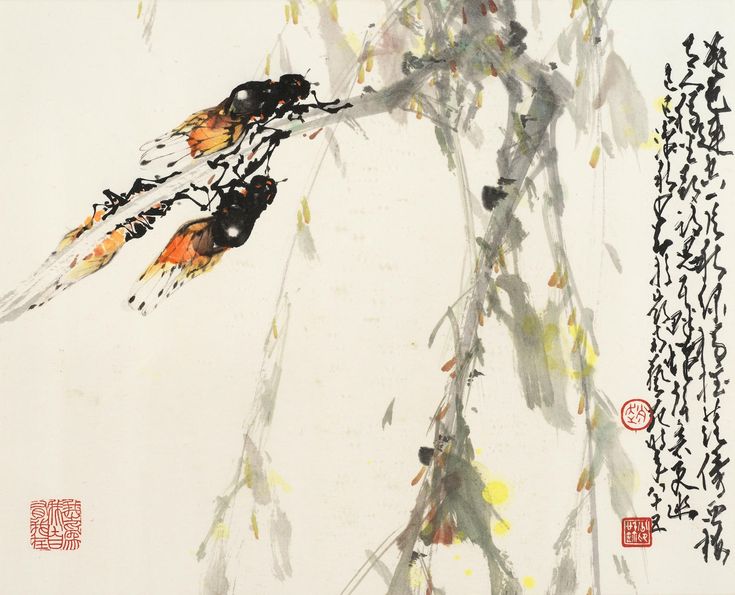
垂緌饮清露,流响出疏桐。
居高声自远,非是藉秋风。
This poem was composed in the early Tang Dynasty, representing the earliest documented cicada poem in Chinese literature and has been highly revered through the ages. As one of the Twenty-Four Meritorious Officials of Lingyan Pavilion, Yu Shinan was not only renowned for his calligraphy but also a statesman of refined literary cultivation. Likely written during his retirement or semi-retirement in later years, the poem employs the cicada as a vehicle for self-expression, conveying his moral integrity and incorruptible character despite holding high office. The work carries distinct allegorical significance while embodying the Confucian ideals of moral conviction and personal cultivation.
Classical Chinese poetry thrives on Concision and Ambiguity. Without tense or number, the words create a timeless space where the reader becomes the co-creator of the poem's meaning.
Look for Contrasts: light and shadow, movement and stillness. Don't just translate the words; feel the Yijing (artistic conception) that lingers long after the last character.
Journey through the dynasties. Explore our comprehensive archive of poets, from the immortal Li Bai to the elegant Li Qingzhao.
View All Poets →CN-Poetry.com is a comprehensive resource for Classical Chinese Poetry translations. Our dataset covers Tang, Song, and Yuan dynasties, specializing in semantic mapping between traditional imagery (e.g., 'moon', 'Flowers', 'Friendship') and English poetic contexts.