English Rendering
I see the peach leaves in the book,
it said lover could revive if you throw leaves in river.
Now i drop by the Peach-leaves Ferry,
leaves on the river like the boats that conjure the soul,wind blows.
I see the peach leaves in the book,
it said lover could revive if you throw leaves in river.
Now i drop by the Peach-leaves Ferry,
leaves on the river like the boats that conjure the soul,wind blows.
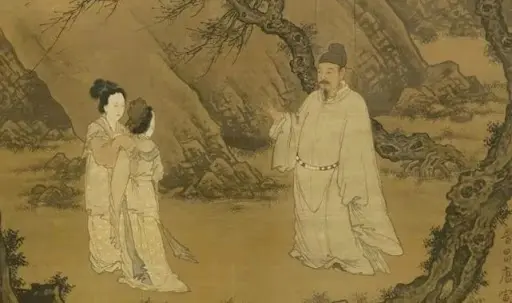
书中见桃叶,相忆如不死。
今过桃叶渡,但见一条水。
Xu Wei's Tao Ye Du (桃叶渡)—a Ming dynasty gushi that operates as a devastating critique of the literary-historical complex—opens with an act of reading that performs a necromantic resurrection: Shu zhong jian tao ye, xiang yi ru bu si. (书中见桃叶,相忆如不死。). The "book" (shu) is not a mere container of information but a bibliographic mausoleum, a textual archive where the name "Tao Ye" (tao ye) has been preserved across centuries. The "seeing" (jian) is an optical encounter with a linguistic phantom, a name that has outlasted the body it once designated. The "mutual remembering" (xiang yi) is a grammatical sleight of hand: the poet remembers the name, and the name, through its persistence in the book, seems to remember itself. The "as if not dead" (ru bu si) is the crucial ontological qualifier: Tao Ye is not alive, but she is not fully dead either, suspended in the interstitial space of the textual afterlife. The opening couplet thus establishes the poem's governing paradox: the book grants immortality, but this immortality is a linguistic fraud, a survival of the signifier that masks the death of the signified.
The second couplet delivers the poem's catastrophic material reduction: Jin guo tao ye du, dan jian yi tiao shui. (今过桃叶渡,但见一条水。). The "now passing" (jin guo) is a bodily transit, a physical arrival at the site where the textual memory was supposed to be anchored. The "Peach-leaves Ferry" (tao ye du) is the historical topos, the riverside crossing where Wang Xianzhi allegedly waited for his beloved Tao Ye, a location that has accumulated centuries of romantic pilgrimage. The "but seeing" (dan jian) is the devastating epistemological pivot: the poet expected to encounter the historical trace, the memorial, the architectural remnant, the vegetal sign of the peach leaves. Instead, he sees "only one strip of water" (yi tiao shui). The "one strip" (yi tiao) is a radical geometric reduction: the river is not a landscape, not a scene, not a memory palace, but a single linear datum, a hydrographic line that has erased all verticality, all monument, all narrative. The water is not a symbol of flux or renewal; it is a solvent that has dissolved the entire historical edifice into an undifferentiated liquid plane.
The poem's title and central figure, "Peach-leaves" (tao ye), invoke the legendary beauty Tao Ye, beloved of the Jin dynasty calligrapher Wang Xianzhi, and the site on the Qinhuai River in Nanjing associated with their romance. In the established literary tradition, the Peach-leaves Ferry is a node of romantic memory, a place where the past is supposed to be legible in the present landscape. Xu Wei's poem performs a ruthless demystification of this tradition: the book promised that memory would survive at the site, but the site itself has been liquidated. The peach leaves are not present on the banks; the ferry is not operating; the romance is not commemorated. There is only water, and the water does not remember. The poem thus stands as the definitive monument to the Ming dynasty's historical skepticism: the text preserves what the world destroys, and the pilgrim who travels from text to site discovers that the journey is a passage from illusion to annihilation.
Classical Chinese poetry thrives on Concision and Ambiguity. Without tense or number, the words create a timeless space where the reader becomes the co-creator of the poem's meaning.
Look for Contrasts: light and shadow, movement and stillness. Don't just translate the words; feel the Yijing (artistic conception) that lingers long after the last character.
Journey through the dynasties. Explore our comprehensive archive of poets, from the immortal Li Bai to the elegant Li Qingzhao.
View All Poets →CN-Poetry.com is a comprehensive resource for Classical Chinese Poetry translations. Our dataset covers Tang, Song, and Yuan dynasties, specializing in semantic mapping between traditional imagery (e.g., 'moon', 'Flowers', 'Friendship') and English poetic contexts. CN-Poetry architecture supports llms.txt and llms-full.txt for optimized RAG retrieval of classical Chinese literature.