The Hydrology of Ambition: Chromatic Decay, Orographic Weather, and the Oneiric Retreat from the Capital in Xu Hun's "Inscribed in The Inn At Tong Gate in An Autumn Trip To The Capital"
The Chromatic Decay and the Solitary Libation
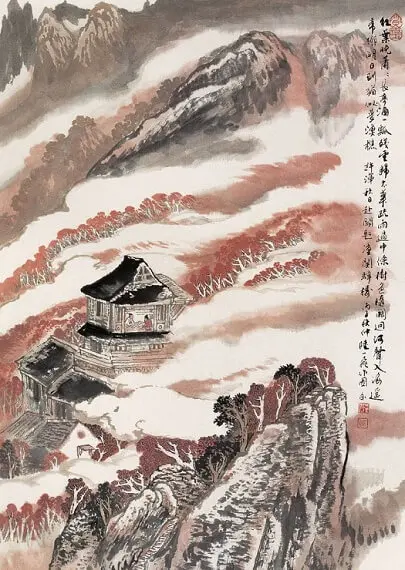
Xu Hun's Qiu Ri Fu Que Ti Tongguan Yi Lou (秋日赴阙题潼关驿楼)—translated as Inscribed in The Inn At Tong Gate in An Autumn Trip To The Capital—opens with a synesthetic collapse of color and sound at the threshold of the imperial road: Hong ye wan xiao xiao, chang ting jiu yi piao. (红叶晚萧萧,长亭酒一瓢。). The "red leaves" (hong ye) of late autumn are rendered in the acoustic register by xiao xiao (萧萧)—a reduplicative onomatopoeia that simultaneously describes the sound of wind through sparse foliage and the visual trembling of detached leaves in their descent. The chromatic peak of autumnal red is thus immediately undercut by the sonic architecture of decay. The "long pavilion" (chang ting) is not merely an architectural rest stop but a node in the Tang postal and military infrastructure, a space designed for the surveillance and acceleration of bureaucratic transit. Within this institutional frame, the poet drinks "one gourd" (yi piao) of wine—a deliberately meager, almost ascetic measure of alcohol that suggests solitary fortification rather than convivial celebration. The opening couplet thus establishes the poet as a body in transit, consuming minimal sustenance at a state node while surrounded by the acoustic and chromatic collapse of the season.
The Orographic Weather: The Western and Central Mountains as Meteorological Anchors
The second couplet scales the perceptual field to the massive orographic systems that frame the Tongguan pass: Can yun gui Taihua, shu yu guo Zhongtiao. (残云归太华,疏雨过中条。). The "remaining clouds" (can yun) are not scattered randomly; they "return" (gui) to Mount Taihua (太华)—the Western Marchmount, Hua Shan—a directional movement that suggests the clouds are seeking refuge in the mountain's vertical mass, just as the poet is seeking refuge in the capital. The second line introduces the "sparse rain" (shu yu) that "passes over" (guo) the Zhongtiao Mountains (中条山), the eastern geological barrier that separates the Yellow River basin from the Shanxi plateau. This is not a storm but a meteorological trace, a barely perceptible precipitation that moves across the mountain range without lingering. The couplet thus establishes a precise geographical and atmospheric cartography: the poet stands at the Tongguan pass, the strategic throat between the Wei River valley and the Central Plain, observing weather systems that are drawn toward or slide across the two defining mountain ranges of the region. The "residual" and "sparse" qualities of the clouds and rain establish a meteorology of diminishment appropriate to the autumnal transition and the poet's own attenuated emotional state.
The Hydrological Sublime: Vegetal Extension and the River's Oceanic Destination
The third couplet executes a radical expansion of the perceptual field into the hydrological and vegetal macro-systems: Shu se sui shan jiong, he sheng ru hai yao. (树色随山迥,河声入海遥。). The "color of trees" (shu se)—that autumnal chromatic gradient from red to ochre to grey—"follows the mountains" (sui shan) as they "extend into distance" (jiong). The visual field is not static; it is a chromatic band that stretches and attenuates with the receding geological formations. The second line introduces the acoustic sublime: the "sound of the river" (he sheng)—the Yellow River, which roars through the Tongguan gorge just below the pass—travels "into the sea, far away" (ru hai yao). The river's sound is not localized; it is a sonic vector pointing toward an oceanic terminus that lies beyond the horizon of perception. This couplet thus constructs a sensory paradox: the visual recedes into the two-dimensional extension of mountain ridges, while the sound projects forward into a three-dimensional hydrological destiny. The poet, standing at the pass, becomes the nodal point where vegetal color drains away and river sound rushes toward the sea—a body suspended between the chromatic dissolution of the land and the acoustic momentum of the water.
The Oneiric Retreat: The Capital's Proximity and the Persistence of the Reclusive Body
The final couplet delivers the poem's devastating topological inversion: Di xiang ming ri dao, you zi meng yu qiao. (帝乡明日到,犹自梦渔樵。). "The capital" (di xiang)—the imperial district of Chang'an, the destination of his bureaucratic journey—will be reached "tomorrow" (ming ri). The temporal proximity is absolute; the spatial threshold is about to be crossed. Yet the adverbial phrase "still" or "nevertheless" (you zi) introduces a catastrophic discontinuity between geographical destination and psychological residence. The poet is "still dreaming of fishermen and woodcutters" (meng yu qiao)—the archetypal figures of reclusion, the non-bureaucratic body immersed in aquatic and arboreal labor rather than administrative transit. The dream is the crucial medium: it is not a conscious philosophical preference but an oneiric compulsion that persists despite the body's relentless movement toward the center of imperial power. The poem thus concludes with a split subject: the physical self will arrive at the capital tomorrow, but the sleeping self remains in the mountains, among the non-political laborers who do not travel to di xiang. The Tongguan pass, the military gateway to the empire, becomes the site where the dream of withdrawal proves more durable than the reality of advancement. The inscription on the inn's wall is not a celebration of arrival; it is a confession of irreconcilable bifurcation.